
The European Cereal Market Cycle
-Monday, June 12, 2000
This analysis featured in the June 12, 2000 issue of the HGCA's MI Prospect, Volume 2, Number 25
This article provides a reminder of how European cereal markets work with changing market conditions, reviews current and emerging prospects and offers advice for next season when markets could come under the direct influence of world prices.
Key Points
- EU markets have cycled back to early 1990's conditions.
- Next season they could come under the influence of world prices
- Setting price or timing sales objective is important
On a day-to-day basis the bulk of European cereal trade appears to occur in an open manner and without regulation. Intervention, or the export licensing system, or both, are however almost always in the background influencing price levels.
Intervention is a "passive participant" in the market. Acting as something of a buyer of last resort, it provides, in theory, an unlimited market for grain at set prices. There are, of course, time and quality restrictions, but they are general enough for intervention to provide a floor.
The export licence system, operated by the Commission's Cereal Management Committee, MANCOM, is more active and complex. In simple terms its job is to bridge the gap between EU and world markets. Normally this means providing restitution or subsidies for the export of grain and offering grain from intervention stores at internationally competitive prices.
Eventually all grain produced but not consumed in the EU has to be exported. In an ideal world MANCOM would at its weekly tenders simply mop up any grain surplus to immediate needs in the EU market by offering export subsidies to cover the difference between EU and world prices.
In the real world it faces the challenge of assessing the short term international demand for EU grain and adjusting the export supply to meet it. If it is too aggressive, it will tend to increase the gap between EU and world prices, typically at the expenses of the latter. If it limits exports too much, offering too little export inducement, it will narrow the gap normally at the expense of EU prices.
MANCOM is further restricted by a limited budget and, increasingly, the need to observe the EU's international trade commitments on the volume of, and expenditure on, export subsidies. It typically finds itself in one of four general situations. Over the last eight years we have seen all of them.
When international market conditions are improving, there is generally safe ground for MANCOM between offering too much and too little for export. It can allow the gap between international and European prices to narrow, prices to rise, or to sell intervention grain. During the 1993-94 and 1994-95 seasons the gap between world and European prices declined, intervention stocks were sold offexport and subsidies were cut back, see Chart 1 and 2.

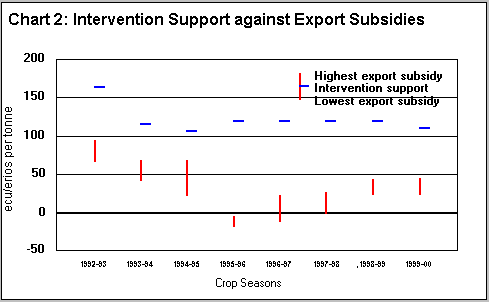
continued
On occasions when international prices rise above intervention levels, MANCOM plays a role in stabilising European prices by selling off intervention stocks, and in the past has even charged for export licenses, effectively taxing exports. This happened during 1995-96 and early in the 1996-97 season. Intervention stocks had already been been exhausted and MANCOM relied on export license charges to stabilise European prices.
When world market conditions are sliding, too much and too little export subsidy overlap. MANCOM is faced with the dilemma of pressuring international market prices, or letting the EU market prices decline, or seeing the surplus grain go into intervention. This was the case for much of the 1996-97 and 1997-98 seasons. Export subsidies were reintroduced and generally increased over this period, but MANCOM was successful in holding prices above the intervention floor until early in 1998, delaying the build up in intervention stocks.
At times when world market conditions are weak MANCOM has to rely on both export subsidies and the expensive option of intervention to balance supplies. From early 1998 and through the 1998-99 season intervention stocks rose to 14.6 million tonnes whilst export subsidies at times reach e40 per tonne for common wheat.
top of pageThis year export subsidies declined for both wheat and barley as world prices improved, particularly for barley, and the euro weakened against the dollar. MANCOM has also been successful in selling off intervention stocks which are expected to fall to about 9 million tonnes.
Further, current international prices for new crop have on occasion been above next season's intervention support level. This reflects the first reduction in intervention prices under Agenda 2000 and the weakness of the euro, rather than, as yet, much in the way of sustained improvement in international market conditions.
Any strengthening in international grain market conditions will, however, be reflected in European markets much more quickly than in the early 1990's, as the intervention support is lower and intervention stocks are less burdensome than they were then.
Further, early season world supply and demand projections for the coming season for wheat, if not for coarse grains, point to tighter world wheat supplies than they did a year ago (see mi prospects issue 24). American new crop wheat prices are currently about 5 percent higher in dollars terms than a year ago, but close to 25 percent higher in euros.
Also note, new crop wheat prices dropped by about 15 percent last year between spring and autumn, as world production prospect improved by about two percent. Changes in world production estimates of this magnitude, in either direction, are not unusual.
European market scenarios for 2000/2001 range from
a) another season very much like this one,
b) through one where European prices are being driven by the international market somewhere above invention,
c) to one where export taxes are threatened to stabilise price and protect the EU livestock sector.
The most probable scenarios are (a) and (b.) The latter would result from currency exchange rates stabilising about where they are now and current early world supply demand projections proving to be relatively accurate. The former could be the case if world production is better than forecast, consumption is below forecast or the euro strengthens against the dollar.
top of pageIf the EU price scenario is similar to (b), it will be a challenging year in terms of pricing and timing. Not only will EU prices swing with the international market, but the threat of export taxes would also be ever present, particularly if prices show signs of increasing significantly.
In such situations farmers' worst enemies are psychological, greed when the market is rising and panic when it is falling. To avoid falling prey to these, it is best to set price or timing sales objectives, review them periodically, but stick with them as much as possible.
David Walker 01603 705153
top of page