
Oats Situation and Outlook
- Monday, February 17, 2003
This analysis featured in the February 17, 2003 issue of the HGCA's MI Prospect, Volume 5, Number 17
World oats trade is based around US imports and Canadian and Scandinavian exports. With the small crop in Canada, Scandinavia is replacing exports to the US this season. UK prices struggle to benefit from stronger international milling oat prices due to relatively small surplus produced in the UK.
Key points
- US key importer
- Supplied by Canada and Scandinavia
- Canadian crop small again
- Scandinavian exports benefitting
- UK prices dislocated from strong international values.
Oats are grown widely throughout temperate regions of the world, often in areas with less favoured growing conditions and for local, or on-farm, consumption. Production until relatively recently had been in a long term decline as other cereals have provided better returns to farmers and the traditional use as feed for working horses diminished into obscurity.
More recently, as the proportion of oats used for milling for human consumption has increased, even if actual growth has been modest, and as the recreational horse population has increased, the character of the oats market has begun to change.
This has been very evident in the North American market in the last two years, even if conditions have been exceptional. While oats have traditionally sold at a discount to maize because of their lower feed value, over the last two last years reduced Canadian supplies of milling quality oats have resulted in oats selling at significant premiums to maize(Chart 1).
continueChart 1
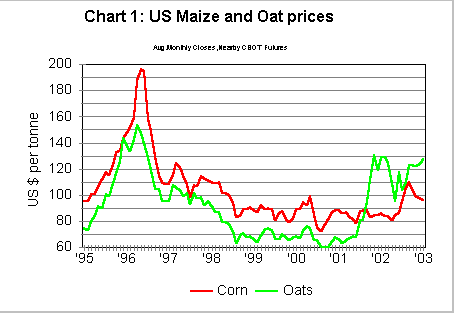
Source: Agdata; Alberta Agriculture
continued
World oats production appears to have stabilized over the last five years at slightly less than 15 million tonnes, after having declined by 50 percent over the previous 20 years. Oats production accounts for less than two percent of world coarse grain production which has increased by over 50 percent during this same period.
International trade in oats likewise is restricted in quantity and scope. It is typically little more than two million tonnes compared with total world trade in coarse grains of about 115 million tonnes. Although the US dominates export markets for coarse grains, paradoxically it is even more dominant as an importer of oats, typically taking over 75 percent of world oats trade.
The bulk of this trade is in milling oats imported across the boarder from Canada into northern mid west states where the US oat milling industry is increasingly centralized. Typically Canadian oat production exceeds domestic and US milling demands, and buyers are largely protected from the competition of overseas markets by the high costs of shipping oats to tide water.
This transportation situation has, however, worked against the millers and for the farmers during the last two years as supplies of milling quality oats have been dramatically reduced by very adverse growing and harvesting condition. Demand for milling quality oats have exceeded supplies and Canadian farmers have been protected by the high costs of importing oats.
The other two major participants in the US market are Sweden and Finland who usually service more southerly US markets where equestrian demand is more dominant and where off shore suppliers have a transportation advantage. This year the premium for milling oats has been such that Scandinavian oats have been imported into the heart of America. The cost of doing this is, however, such that much of the premium paid for these oats is absorbed in transportation costs. As a result, European prices have not reflected milling oat prices paid to Canadian farmers.
It is evident that European exports are, however, benefiting in terms of volume. As the cost of the oats in a highly branded breakfast cereal or indeed in the stabling of a horse is relatively modest, US demand for high quality imported oats is inelastic and little effected by price. The USDA projects US imports this season of about 1.75 million tonnes, while Agriculture Canada projects its exports to all destination of under 900,000 tonnes.
With Australia, the only other significant source of oats, suffering from a drought, Sweden and Finland have a ready market for their 2002 harvest which was a favourable in terms of quantity and quality. At the beginning of February the EU had granted licenses for the export of 620,000 tonnes of oats, about 60 percent above last year's level. Whether the EU will meet the USDA's expectation of exports of 1.2 million tonnes for the current crop year is open to question. But EU supplies of milling quality oats are very tight even though the EU oats harvest is the largest since 1990.
The UK 2002 oat harvest of 755,000 tonnes was the largest in 25 years. The area seeded to oats has increased by 25 percent in five years, although, at 126,000 hectares, it is still less than four percent of total cereal acreage. Yield and quality, excepting in Scotland, has generally been good.
But with domestic demand for milling and equestrian oats being relatively inelastic, potentially surplus supplies have in the main to find a place in general feed and export markets(Chart 2). Because oat production is relatively widely distributed, the domestic millers take much of the better quality supplies and total production is relatively modest, it is difficult to procure sufficient volume of milling quality oats to take advantage of North American markets. It is for these reasons that the fancy North American prices have not been reflected in UK markets.
continueChart 1
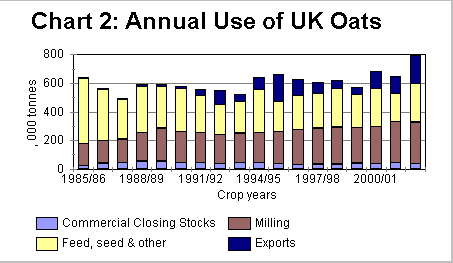
Source: H-GCA
continued
Having said this, however, the trade has been successful this year in moving potentially surplus oats supplies into European markets. By November UK exports had reached 90,000 tonnes, 50 percent above year earlier levels and seem well set to reach record levels for the year as a whole of about 200,000 tonnes.
If there is any linkage between the North American-Scandinavian oats trade axis and the UK market, it is through the general European feed market. It has provided the opportunity for the movement of supplies surplus to domestic needs, if not the the higher prices paid for large cargoes good quality milling oats.
International prospects for next season depend on Canadian production. If the Prairie growing season is close to average, the oats market will, other things being equal, revert to its normal condition. It is tempting to suggest, supported by weather probabilities, that this is likely to happen. But production prospects are somewhat different this year, even if long term weather forecasts are as uncertain.
A year ago the oats market was head and shoulders above most other options for Canadian farmers and this resulted in a 26 percent increase in seeded acreage. This year supplies of almost all Canadian grain and oilseeds are very tight. Hence oats acreage is expected to decline. Oats production is also increasingly concentrated in the eastern Prairies closer to the US millers and away from the worst effected drought areas. Supplies of Canadian milling oats will thus be dependent on favourable harvesting as much as a break in the drought.
In any event price linkage between the North American oats market and the UK is a best limited. Oats do provide favoured production options to some UK growers. While events in the North American markets of the last two years suggest the character of this market is beginning to change, it will be several years before this is very evident in the UK market. Agronomic considerations will, therefore, continue to be important to farmers contemplating oat production.
David Walker
phone: 01603 705153
top of page