
Canadian Crop Situation
- Monday, September 1, 2003
This analysis featured in the September 1, 2003 issue of the HGCA's MI Prospect, Volume 6, Number 5
Key points
- Canadian cereal crops mostly OK despite recent heat/dryness
- Pre-planting rains gave crop the edge over 2002
- Likely return to prominence in milling and malting markets
- Some questions over milling oat availability
- Concerns for 2004 crop similar to this time last year
Canadian cereal and oilseed crops look to have recovered from the drought-ravaged 2002 crop. They are expected to re-take key export markets, particularly for milling wheat and malting barley. Although recent conditions have been dry, pre-planting rains look to have saved the 2003 crop. Although still some way from planting, prospects for the 2004 crop are not being taken for granted and could depend heavily on moisture availability over winter and spring.
Much has been made of the hot and dry conditions in western Canada in recent weeks, but Statistics Canada's first production projections indicate a marked recovery in yields from a year ago to levels generally not much below long term averages.
Table 1: 2003 Canadian Crop Production Projections
----------------------------------------------------
          10-year avg     2002      2003   2003/2002
Crop            '000t    '000t	   '000t    % change
----------------------------------------------------
Total wheat    23,676   15,690    20,966       34
Durum           4,354    3,714     3,778        2
Barley         12,305    7,283    12,025       65
Canola          6,350    3,577     6,230       74
Oats            3,484    2,749     4,048       47
Flaxseed          919      679       793       17
Rye               306      134       301      125
Soybeans        2,411    2,220     2,560       15
Maize           5,380    8,657     8,788        2
----------------------------------------------------
Source:  Statistics Canada, based on July 31 survey.
It is tempting to equate this year with last in terms of drought reduced yields. But the two years are very different in terms of crop development. And while yields this year will almost certainly be below average, they will not be at the very low levels of last year.
In contrast to the previous year, moisture received since last year's harvest and through until this spring was above average, particularly so in areas most effected by the drought last year. During June general prospects were for at least average yields even in areas which were most severely affected by drought last year.
It was not until late July that concerns about yields emerged. In contrast the damage last year started in early July when crops without any subsoil moisture reserves quickly deteriorated. Only in parts of Manitoba have severe or moderate drought conditions developed (see map). Last year such conditions covered almost all central and northern farming areas in both Alberta and Saskatchewan.
continueChart 1
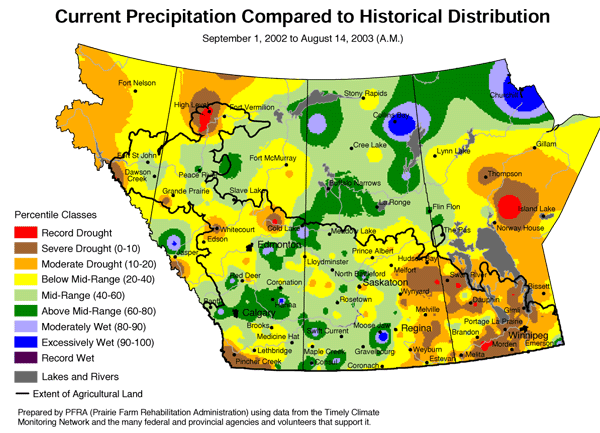 Source: Prairie Farm Rehabilitation Administration
continued
The difference between the two years was confirmed by Statistics Canada's first field crop production projections (see table). Production of almost all crops has improved materially, although output remains still below long-term averages. With the exception of canola and summer fallow, seeded areas were not materially changed from last year.
The increase in projected output reflects improved yields and a reduction in crops abandoned or harvesting for forage. The increase in canola area was indirectly at the expense of summer fallow, which reflected favourable moisture conditions at seeding time.
These Statistics Canada production projections, published on 22 August, however, may understate the impact of the dry and hot conditions in August as they were based on 31 July conditions. It should be noted however that wheat, which dominates output from the worst effected areas, is more drought resistant and was closer to maturity.
Swathing of cereal crops in eastern areas of the Prairies was fairly general by mid August, about ten days to two weeks earlier than usual. What is evident is that the wheat harvest will be of high quality.
Areas further north and west, where maturity is generally later, have received some rain in the last month and so may have also escaped the worst of the hot and dry conditions.
Wheat
A crop of almost 21M tonnes will go a long way to enabling Canada to service the requirements of its traditional customers again. After allowance for domestic requirements and some rebuilding of stocks, about 13.5M tonnes will be available for export. Last year excepted, Canada has typically over the last 10 years exported between 15 and 20M tonnes annually. So this improved supply situation will hardly be burdensome, particularly in the context of its potential high quality. Durum is the one crop where production is not expected to increase. It is grown almost entirely in the southern Prairies where it escaped the worst of the drought last year.
Barley
Statistics Canada projected production this year at slightly more than 12M tonnes, 65 percent above last years drought-devastated crop. Yields, particularly for two-row barley in western and northern regions, have improved and non-combined area reduced. They may, however, be more susceptible to the dry conditions in August than wheat. This suggests about 4M tonnes will be available for export as grain or stocks, compared to 2.1M tonnes last year.
With subsoil moisture in many areas as low as it was a year ago the livestock feeding industry will likely place a high priority on rebuilding feed inventory after last year's experience of absolute shortages. Unless and until subsoil moisture is replenished, exportable supplies of Canadian barley will be limited to around 2M tonnes. While much improved over last years 900,000 tonnes, this is still a relatively tight supply situation for Canada.
In all likelihood the bulk of exports will be malt or malting barley. As last year this will be contingent upon suitable quality barley being available, but with as much as 80 percent of Canadian barley being seeded to malting varieties and barley being grown over a large geographic area Canada has unusual flexibility in this respect. Even with last years very small crop it was possible to select 1.1M tonnes from a crop of 7.3M tonnes.
This year barley in the more southern areas will possibly, with high protein content, be more suited for feeding than malting. But with reasonable harvest conditions in more northerly areas supplies of suitable barley, particularly two row varieties, are likely to be adequate to accommodate a significant increase in malting barley exports.
The prospects for malting barley are probably well reflected in the Canadian Wheat Board Pool Return Outlooks. Current pool return projections for Special Select (malting) two-row barley for this year are Can$159.00 (about £70) per tonne, over Can$80 lower than current projections for last year of Can$241.00 (about £110) per tonne. For feed barley the current projection for this year is Can$147, compared to Can$158 for last year.
Oats
Canadian oat production is forecasted to be just over 4M tonnes, 47 percent above last years drought-reduced crop. Critical for the milling oats market is bushel weight. While earlier seeded wheat and barley crops are reported to have favourable bushel weights, oats tend to be planted later which may count against it. The large increase in oats production may not, therefore, resolve totally the critically short North American milling oats' situation.
Canola
Statistics Canada projects Canadian canola production at 6.2M tonnes, 74 percent above last year's output. Of this 60 percent came from an increase to harvested area. Yields are higher than last year but the biggest difference comes from a large reduction from the unusually high crop abandonments last year. This year's projected canola crop is close to 10-year average output. While the canola crop may have suffered more than other crops from hot and dry conditions since this projection was made, Canada will almost certainly have a large enough harvest to rebuild stocks and supply its priority export markets.
Post Script for 2004
While it is certainly too early to make any sort of projection for next year, it should be noted that subsoil moisture conditions are again poor over much of Western Canada. In terms of prospects for next year, the situation is not materially different from a year ago. While much above average snow and rain fall last autumn, winter and spring enabled soil moisture conditions to be replenished for seeding, this was used in sustaining the 2003 crop during dry conditions in June and July.
David Walker
phone: 01603 705153
top of page