
US Grain Consumption
- Monday, December 22, 2003
This analysis featured in the December 22, 2003 issue of the HGCA's MI Prospect, Volume 6, Number 13
Key points
- Strong growth in non-food use of US grain
- Maize use for ethanol expected to exceed total wheat food use
- World markets less influenced by US production
- Environment and engergy security important for future growth
Over the last two years two long-standing rules of thumb, that small US grain crops are good news for international grain markets and big US grain crops are bad news, appear to have been broken. While there have, of course, been other factors at play, there is little doubt that the influence of US output on the international marketplace is declining and the quiet growth in US domestic consumption has been a major influence.
Conventional wisdom was that long term growth in global grain consumption would come mainly from less developed economies where growth in population and income would result in increased food consumption. In more developed economies growth in population is slower and income is such that increases are likely to be spent on less essential expenditures than food. During the 1960's, 1970's and 1980's this certainly seems to have been the case.
While consumption in any particular year is dependent on supplies, longer term trends suggest that the rate of growth in consumption globally has slowed, while that of the US has increased. The increase in grain consumption in the US has resulted almost entirely from the growth in consumption of maize, generally, and in its industrial and food use, in particular.
Traditional use of grain
The USDA forecasts US consumption of all grains this year at 252 million tonnes. Of this nearly 60 percent is used as livestock and poultry feed with 90 percent of this being maize. Maize accounts for about 80 percent of total US grain consumption(Table 1).
Table 1: US Grain Use, 2003-04 Forecast
------------------------------------------------
                                Million  Percent
                                 tonnes of total
------------------------------------------------
Maize for feed                    144.8    57.4%
Maize for fuel alcohol             27.9    11.1%
Wheat for food                     24.8     9.8%
Maize for other non feed           20.8     8.2%
Maize for HFCS                     14.1     5.6%
Other grains for feed               8.4     3.3%
Wheat for feed                      6.1     2.4%
Other grains for other non feed     5.4     2.1%
------------------------------------------------
Total                             252.3   100.0%
------------------------------------------------
Other non-feed includes starch, glucose and dextose,
beverage alcohol, breakfast cereals etc.
Other grains include sorghum, barley and oats.

Source:   USDA
The dominant position of maize in US livestock consumption is long standing and growth has and is likely in the future to be tied to the relatively steady and modest increase in livestock and poultry consumption. Over the last 15 years US maize feed use has increased by about 30 percent which equates to about 1.8 percent per year.
Likewise food consumption of grains currently about 35 million tonnes, of which 25 million tonnes is wheat, is relatively stable with wheat consumption having increased by about 7 percent over the last 15 years, or about 0.5 percent per year.
The unexpectedly robust growth in US grain consumption, however, stems in the main from two relatively new products, fuel alcohol or ethanol and corn sweeteners or HFCS(Graph 1). Use of maize in the production of these two products has increased by 140 percent over the last 15 years, or about 6 percent per year.
continue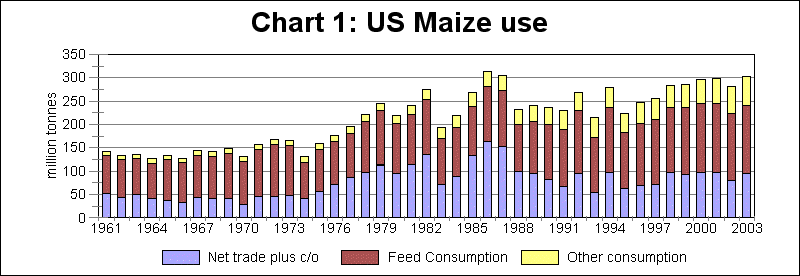 Source: USDA
continued
Fuel Ethanol
Ethanol has been produced from maize for solvents and pharmaceutical purposes for a long time and for whisky for a very long time. But interest in ethanol as a fuel only developed in the 1970's as a result of the Oil Crisis in the early part of that decade. This was linked to certain environmental advantages in blending ethanol as an oxygenate with conventional petrol resulting in improved octane rating and reduced carbon monoxide emission. But with the development of fuel additives which achieved the same purpose as ethanol and the decline in oil prices, sufficient interest for significant growth did not develop immediately.
More recently with environmental concerns over the fuel additives themselves, higher oil prices and the emergence of energy security as an issue in an increasingly charged international political environment, US government support for ethanol production has been forthcoming. Also the efficiency of the industry in an energy context has improved and no longer seems to be in doubt as it earlier was.
In the last four years US ethanol production has doubled(Graph 2). The use of maize for ethanol production is for the first time this year forecast to exceed that for all wheat for all food purposes - bread, biscuits, cakes, pasta, etc. And it is evident that the rate of investment in ethanol production facilities is such that it will continue to increase.
continue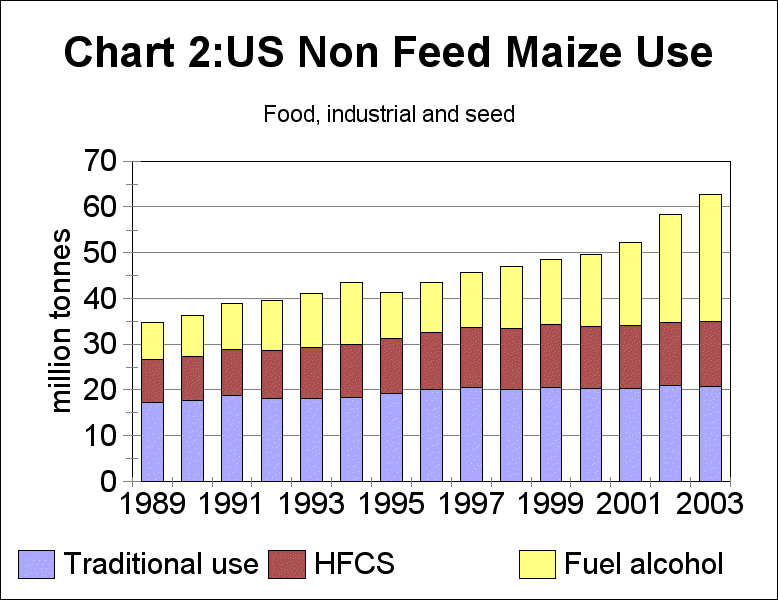
Source: USDA
continued
There are currently 73 US ethanol production plants working very close to their capacity of about 2.9 billion gallons. A further 16 are under construction. A US energy bill, currently stalled in the US Senate but still a top priority for the US President, may result in a further doubling of fuel ethanol production over the next ten years.
While future growth in use of maize for fuel ethanol production will clearly be tied in with US environmental and energy security policy, with considerable infrastructure in terms of processing facilities already in place, use of maize for ethanol consumption is unlikely to decline significantly.
High Fructose Corn Syrup(HFCS)
The production HFCS, also started in earnest in the 1970's. HFCS is about 30 percent sweeter than conventional sucrose sugar per calorie, a significant advantage in today's health conscious market. Improvements in processing and product development have resulted in increased penetration of the US liquid sweetener market where it now dominates the soft drink market and accounts for more than 40 percent of overall US sweetener consumption.
Growth in HFCS consumption in recent years, however, has shown signs of levelling off. HFCS appears to be reaching the limits of its liquid, mainly soft drink, sweetener market. Due to the relatively high cost of shipping HFCS and the political nature of the world sugar market international trade in HFCS is also limited.
Implications for International Markets
Even though the US has harvested a record feed grain crop, US supplies surplus to its domestic requirements are not overly abundant in an historic context, see Graph 1. And, while the strength in feed grain prices is largely a consequence of short crops elsewhere, it is evident that even a record US crop has not been able to compensate for this.
Future trends in US maize use for fuel ethanol and their implications are surely uncertain. If, as was the case after the Oil Crisis in the early 1970's, the major issues on both sides of the market are resolved, then the implication of fuel ethanol consumption will fade. But, as long as the international political situation remains fraught, demand for fuel ethanol has the potential for creating a floor in the grain market, as it seems to be doing in the international sugar market, with the level and effectiveness of the floor tied to oil prices.
David Walker
phone: 01603 705153
top of page