
North American Crop Update
- Monday, June 28, 2004
This analysis featured in the June 28, 2004 issue of the HGCA's MI Prospect, Volume 6, Number 26
Key points
- Exception US field conditions in late May
- US supplies likely to remain tight
- US prices may yet be very volatile
- Canadian crops similar to last year
The positive yield aspect of the very early planting of US spring crops has been largely offset by cool and exceptionally wet conditions in late May. Very favourable summer crop development conditions will be needed if the currently tight US maize supply situation is to ease. Predicted Canadian production of grain and oilseeds will still not generally result in a full recovery of supplies following the drought years of 2001 and 2002.
US spring crop developments
Field conditions in the major US corn and soyabean producing states were extremely favourable for field work in April. Planting progress for maize was generally two and three weeks ahead of the five-year average by mid May when planting was all but completed (Graph 1). Planting progress for soybeans at this time was also running about a week ahead of normal and half completed(Graph 2).
continue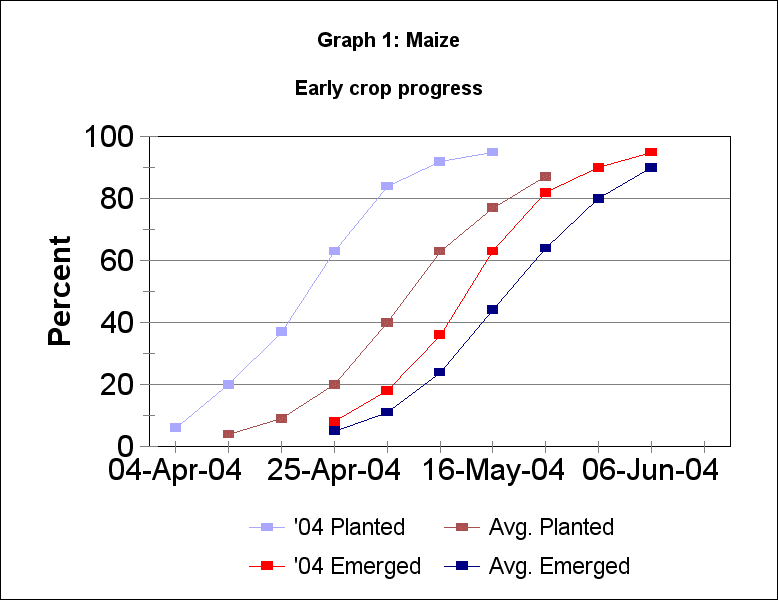 Source: USDA
continued
continue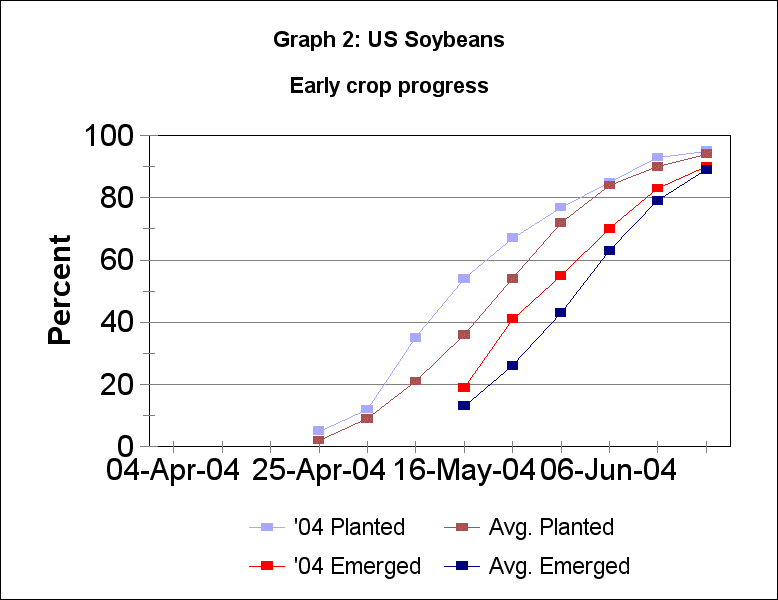 Source: USDA
continued
But with a dramatic change to cooler and very wet conditions, field work slowed. The emergence of most maize crops was only about a week ahead of average and progress in planting and the emergence of the balance of the soybean crop slipped to average.
The water logging of planted crops has in some instances resulted in replanting and perhaps switching from maize to soybeans, with yield losses implicit. Early crop condition reports for maize and soybeans generally place them slightly below average. But most crops are ultimately likely to benefit from excellent to excessive soil moisture conditions.
Although grown mainly in a different region, field conditions for spring wheat development have been similar to those for corn and soybeans. Planting in early May was two weeks ahead of normal but emergence was only about a week ahead(Graph 3). Early spring wheat conditions are also below average. However, with spring wheat is grown in areas where moisture is normally limiting, excellent to excessive soil moisture, although holding the crop back now, is likely to benefit it later in the summer. This assumes that there is not a rapid deterioration of moisture conditions which could leave the crop too shallow rooted to take advantage of sub soil moisture.
continue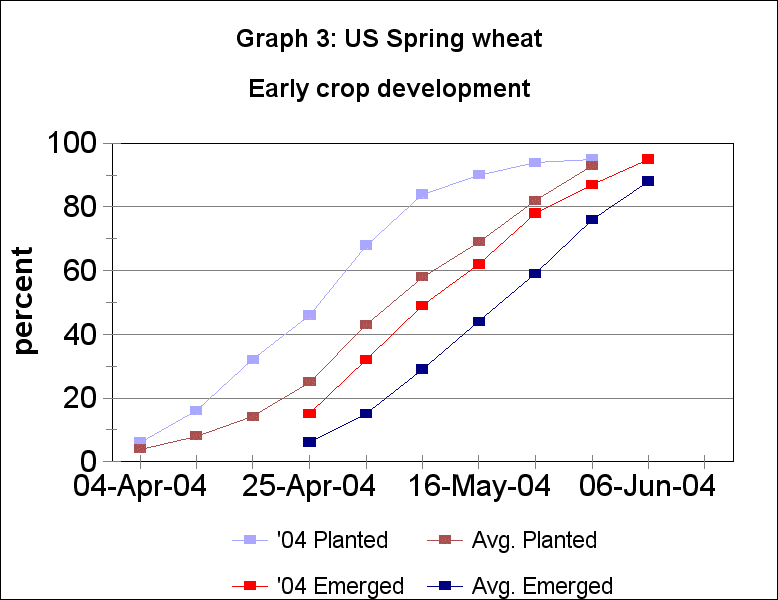 Source: USDA
continued
The condition of the maturing winter wheat crop has slipped somewhat since breaking dormancy but, while currently slightly less favourable than in 2003, is not exceptional(Graph 4).
continue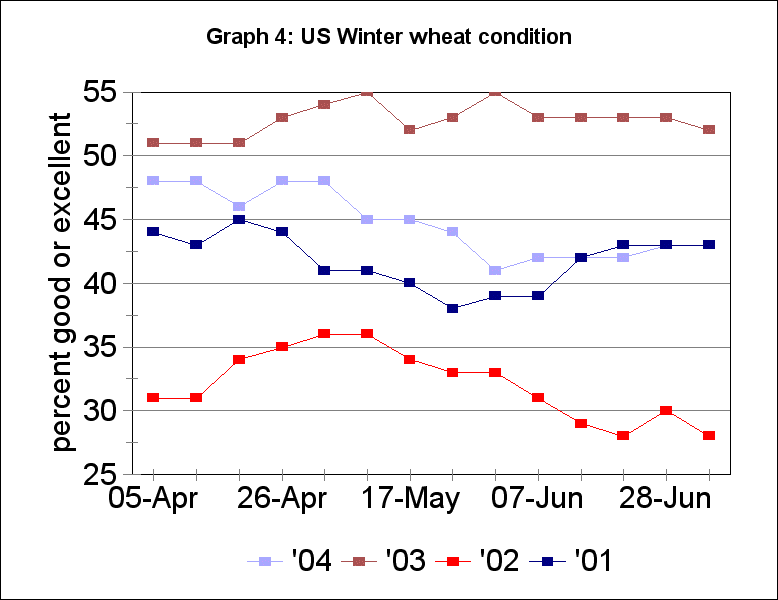 Source: USDA
continued
US yield prospects and implications.
Current USDA projections, using planting prospects survey area and trend yield data, suggest a maize crop of 265 M tonnes, a second successive record. But with USDA's prediction for continued growth in domestic demand, even a crop of this size will result in reduced supplies for export and carryover.
However, with the most critical period for maize and soybean crop development are July and August, respectively, it is difficult to be very precise about the prospects they have created.
December 2004 maize futures have already traded at a high of US$3.40 per bushel (£73 per tonne) in early April when there was concern about prospective plantings. In mid May they traded lower at US$2.80 per bushel(£63 per tonne) when seeding was three weeks ahead of normal. They are currently at the lower end of this range reflecting the expectation that this spring's exceptional weather has not significantly damaged crop prospects.
Given the tight supply balance, any summer weather which is perceived to threaten yield will result in greater price volatility.
For wheat another moderate winter crop is being harvested, although prospects for spring wheat are more positive. The winter crop is now being harvested off a smaller area with the USDA projecting lower yields than last year. Currently a crop of 41.6 M tonnes is projected, 10 percent lower than last years crop. The USDA places the spring crop, using March prospective planting and yield trend data at 14.4 M tonnes, about 15 percent below last year.
Total wheat production is forecast to be 56.08 M tonnes, almost 6M tonnes less than last year. Currently the USDA suggests net exports of 26.54 M tonnes during 2004/05 and lower US end of season stocks at about 13.5 M tonnes.
Given the lower US wheat availabiliity, US pressure on the international wheat market is ecpected to be limited (for a third consecutive year).
Currently, US new crop wheat prices are influenced by world wheat and US maize production prospects, as by US wheat supply deveopments, as well as by US wheat supply developments.
Canadian Prospects
Canadian crop prospects at the end of winter were very similar to those a year earlier - generally very favourable moisture conditions in the eastern Prairies, but still large areas with deficit soil moisture in the west. Similar to last year above average rainfall this spring has materially improved prospects in the west, even if it has delayed seeding in the east. Overall, however, Statistics Canada's satellite imagery suggests that the vegetative condition of Prairie crops in early June was not as favourable as it was at this time last year.
Generally Agriculture and Agri-Food Canada predicted production for most crops similar to last year in early June, Assuning some increase in carryover stocks, total supplies are anticiparted somewhat larger, but still relatively low by past standards. Generally, significant increases in exports and/or carryover stocks during the coming crop year are not anticipated.
The exception to this is for durum wheat where improved yields are expected to result in an 800,000 tonne increase in carryover. This has eroded premiums for this type of wheat rather than impacting on overall wheat prospects.
Canadian barley supplies are expected to increase as carryover stocks were larger and this year's crop is forecast to be similar in size to last year's. Domestic feed consumption is forecast to rise as the US is anticipated to reopen its border to Canadian beef. In contrast overall exports are expected to decline as a result of a recovery in European production, while the malting barley component is expected to increase. Given the recovery from the 2001 and 2002 droughts, supplies of barley have risen to a level where only the quality impact of very adverse harvesting conditions would restrict malting barley export.
David Walker
'phone: 01603 705153
top of page