
Canadian Crop Update
- Friday, September 3, 2004
This analysis featured in the September 3, 2004 issue of the HGCA's MI Prospect, Volume 7, Number 5
Key points
- Wheat quality likley to be lower due to frost
- Possible 10 percent of canola lost to frost
- Barley least effected by early frost
The July 31 Statistics Canada crop projections, published on August 24, suggested that Canadian output of grains would recover to normal levels not seen in the last three years. Earling frosts on August 20 have, however, created fresh uncertainty over the size and quality of Canadian crops. Of the major crops, canola (OSR) is likely to be most severely affected and barley least.
Canadian crop development conditions have, in most respects, been favourable with adequate moisture almost everywhere and no periods of excessively hot weather forcing crop maturity.
At the end of July, when Statistics Canada surveyed farmers for its first estimate of production, crops generally looked in good to excellent vegetative condition, but in many areas were two weeks behind normal development. The estimate from this survey put total production at almost 67M tonnes, up 12 percent, and towards the top end of a typical Canadian harvest range(Table 1). Recovery in output was most evident in the Prairies where a crop of about 57M tonnes was projected (Graph 1).
continueTable 1: Statistics Canada, July 31, 2004 Crop Estimates
-------------------------------------------
2003 2004 2004/2003
M tonnes M tonnes percent
-------------------------------------------
All wheat 23.552 25.624 109
Barley 12.328 13.452 109
Canola 6.669 8.244 124
Oats 3.691 3.780 102
Field peas 2.124 3.382 159
Flax 0.754 0.921 122
Rye 0.308 0.366 119
Maize 9.063 8.277 91
Soybeans 2.113 2.786 132
-------------------------------------------
TOTAL 60.602 66.832 112
-------------------------------------------
Source: Statistics Canada, maize and soybeans Quebec & Ontario only.
continued
continue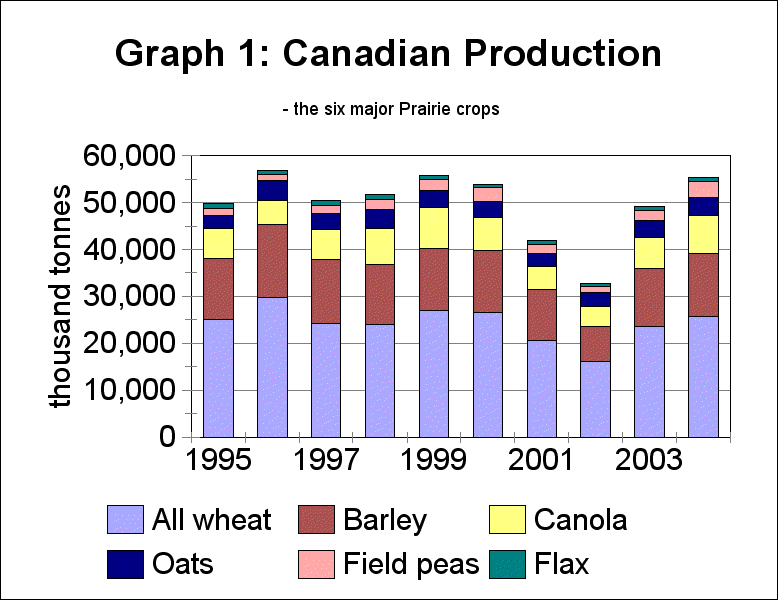 Source: Statistics Canada
continued
A late developing crop is not a problem provided it is not subject to early frosts. First frosts on the Prairies normally occur in early to mid September depending on location. This year, however, much of northern and eastern Saskatchewan and western Manitoba had their first killing frost on August 20.
Accurate assessment of frost damage is difficult and depends on the severity and length of the frost, the crops involved and their state of maturity, and further pre-harvest frosts may yet compound the situation. Under normal circumstances quality rather than yield is lost. This year, however, significant yield losses, particularly for canola(OSR), are already anticipated. Trade estimates suggested as much as ten percent of the canola crop has been lost.
Wheat
Statistics Canada estimated wheat production at 25.6M tonnes, up nine percent from 2003. But the quality of some spring and durum wheats and to a lesser degree the quantity are likely to have been downgraded by the frost. In a marketing context, however, the Canadian Wheat Board(CWB) is likely to have an adequate carryover of higher quality wheat to meet the top end of its traditional markets.
On August 26 the CWB lowered its Pool Return Outlook for spring wheats by about six percent reflecting the decline in international wheat prices over the preceding month. But it did comment that quality concerns in North America and parts of Europe had tempered the growth in overall milling wheat supplies and should provide underlying support. Durum prices were unchanged with quality concerns in North America due to the crop's slow development and an early frost.
Canola
Canola (OSR) production was estimated to be 8.2M tonnes, up 23 percent from last year. But this is just a memory. Trade estimates suggest that 800,000 tonnes were lost to the frost and almost certainly more than this will be down graded from No. 1 Canada, the grade, which tends to be demanded by Canada's major customers having already sparked speculation as to where it will be marketed.
Between early May and early August new crop canola prices declined from over Can$400 (£164) per tonne to almost Can$320 (£135). During August they have risen to about $370 (£156) with half of the increase following the frost. Ultimately, however, soybean product values will determine a ceiling for canola prices.
Barley
Barley production was estimated to be 13.5M tonnes, up 9 percent from 2003. Barley prospects are likely to be least affected by the frost. Not only is there a ready domestic feed market for down graded grain, but the major two-row production region, Alberta, was spared the worst of the frost. Alberta crops are generally in good condition and not late maturing.
In the context of the international two-row malting barley market, the frost is likely to have had little impact and Canada is likely to have more than adequate supplies to meet market demand. It is always necessary, of course, to add the caveat that this assumes reasonable harvesting conditions and the absence of any exception frost incidents on the western side of the Prairies.
The CWB lowered its PRO's for feed barley by about five percent reflecting lower international feed grain values. The CWB left PRO's for select malting barley unchanged citing EU intervention and adverse harvesting condition in north western Europe as being supportive.
Eastern Canada
Canadian maize and soybeans are grown in Ontario and Quebec, in a relatively narrow corridor bounded by the Canadian Shield and the US border, a thousand miles east and south of the Prairies. The climate is warmer and more humid. It is essentially an extension of the US Corn Belt. Canadian production of maize and soybeans is more stable than Prairie crop production and is generally increasing(Graph 2).
continue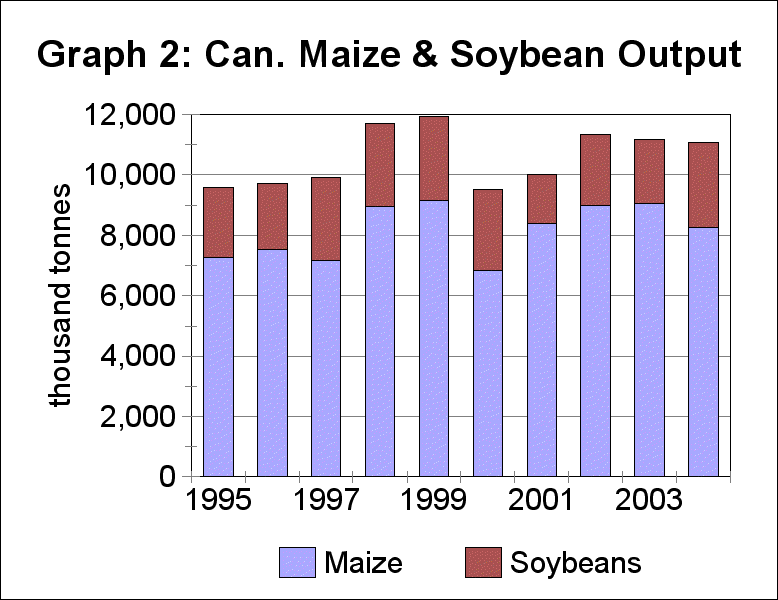 Source: Statistics Canada
continued
Canadian crop prospect for maize and soybeans are not materially different to those for northern US crops. What started out as an early season has developed into a late one with emerging concerns over early frosts, although time frames are a month of so later than those on the Prairies
Also, as in the US, Canadian farmers appeared to have seeded soybeans in preference to maize within agronomic limitations, with price prospects and high fertilizer costs motivating the switch. Unlike the US, there are no major peripheral or marginal areas for maize production to spread into.
Hence, Canadian maize production is expected to fall, by about nine percent with most of the decline resulting from a seven percent decline in area. Soybean production is forecast to increase by 32 percent to a near record level with area up by 15 percent.
While Canadian output can have an impact on trade flows with the US, as the marketing of crops on either side of the border are integrated and Canadian production of both crops is less than five percent of US output, the market impact of Canadian production is limited.
David Walker
'phone: 01603 705153
top of page