
US and Canadian Wheat Quality
- Monday December 13, 2004
This analysis featured in the December 13, 2004 issue of the HGCA's MI Prospect, Volume 7, Number 12
Key points
- Poor harvest conditions affect spring wheat quality
- Canadian quality well below average
- 60% of Saskatchewan crop feed quality
- Higher premiums for higher quality spring wheats
- Canada faces challenge to export feed wheat
The quality of North American spring wheat harvests has been adversely effected by poor harvesting conditions, particularly in Canada where an early frost had a devastating impact on quality. This is reflected in wider than normal premiums for higher quality red spring wheat and the need for Canadian feed wheat to be sold in unaccustomed markets.
While earlier harvested winter crops were generally harvested in good condition, a cool and damp growing season for spring wheat delayed crop maturity resulting in a late harvest under less than ideal conditions in northern US states and positively appalling conditions over much of the Canadian Prairies. As US and Canadian high protein spring wheat dominate this sector of the international marketplace, wider than usual price premiums for these high quality wheats have developed (Graph 1).
Both the US and Canada use grading systems and lab test-based surveys to measure quality. The grading systems were developed before more definitive lab analysis became available. Because of the need for grain to be segregated, or blended, on quality criteria on receipt at country elevators, grading systems were originally based on physically observable characteristics. By way of example bushel weight and vitreous kernels provide an indication of flour yield and protein. These systems have been amended over the years as inexpensive and rapid tests have been developed for, for instance, protein.
The US and Canada have been supplementing this in recent years and undertake post harvest lab test-based quality surveys which provide buyers with more definitive information on the overall wheat quality within the grades.
United States
Hard red winter, grown mainly in northern Texas, western Oklahoma, Kansas and eastern Colorado, is the most important class of US wheat. Last year it represented about 45 percent of both US production and exports. Production of hard red spring wheats, about 21 percent of production and 23 percent of exports, is mainly limited to states on the Canadian border. While soft red winter wheat is grown quite widely east of the Mississippi River and the other two classes soft white winter and durums have restricted production areas, the former in the Pacific Northwest, the latter in the same area as the hard red spring wheats.
USDA’s grading, as opposed to inspection, service is discretionary with wheat tending only to be graded when sold on the basis of its grade. Often grain is sold on sample, or client defined criteria, and is not graded. Grading data does not, therefore, tend to provide a meaningful indication of crop quality. Lab-based survey data provides an indication within grades.
While the geographic distribution of these classes is determined by climate, they have different markets and, therefore, quality needs vary. In a general context quality was not a major issue this year for winter wheat (Table 1). But for the spring wheats a relatively cool and wet summer, excellent for vegetative growth and yield, delayed and prolonged harvest and quality suffered.
continue
-----------------------------------------------------------------------------
Table 1:  2004 US Wheat Quality
-----------------------------------------------------------------------------
            Hard Red Winter Hard Red Spring  Soft Red Winter Soft White  Durum*
Grade                 2 HRW        1DNS         2 SRW        1 SW       1 HAD
-----------------------------------------------------------------------------
Test Weight(kg/hl)
        2004           77.4        80.4          76.7        79.1        80.3
	5-Year avg     78.4        78.9          77.2        79.0        77.7
Protein (%)
        2004           12.7        13.8          10.3        10.3        13.4
        5-Year avg     12.2        14.5          10.2        10.2        14.2
1000 Kernel Weight (g)
        2004           27.8        32.0          31.3        36.0        40.2
        5-Year avg     28.6        29.5          32.4        34.2        36.1
Wheat Falling Number (sec)
        2004            382         339           357         360         356
        5-Year avg      397         363           341         347         301
-----------------------------------------------------------------------------
Source: US Wheat Associates
continued
US spring wheat markets reacted immediately to the prospects of loss of quality and much of the initial premiums which developed have been sustained (Graph 1). On the Minneapolis market the premium for 15 and 14 percent protein hard red spring wheat over than 13 percent is currently about US$1.00 and 50 cents per bushel (£7.20 and £3.60 per tonne), respectively, an increase from levels less than a third of this prior to harvest. On Kansas City winter wheat markets premiums for 13 percent protein over ordinary have remained relatively stable at about 10 cents.
continue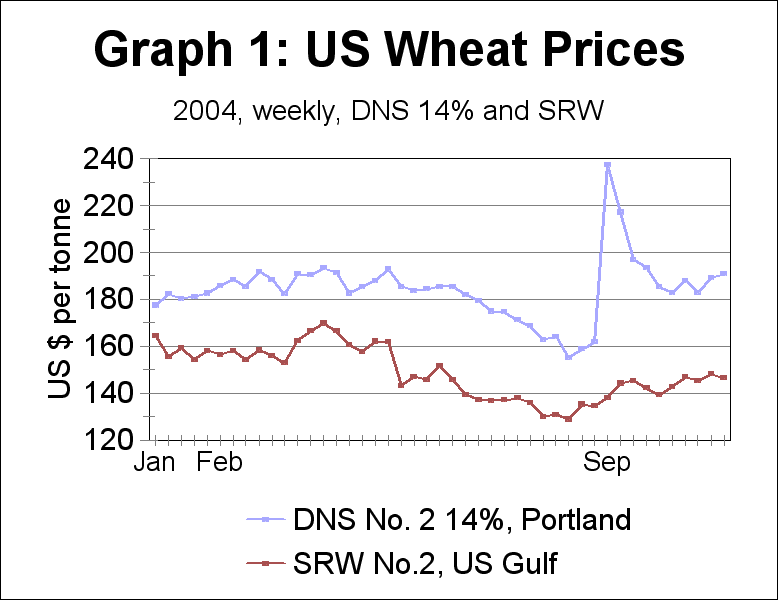 Source: USDA
Canada
The situation for Canada is more serious as the bulk of the wheat harvest is red spring wheat which is grown across the Prairies, destined for quality conscious milling markets. Durum is grown in more southerly Prairie areas relatively close to the US boarder. Some winter wheat is grown in Ontario and in isolated areas elsewhere. In addition there is a limited amount of other spring classes grown under specific conditions with particular markets in mind.
An early frost hit crops over large areas of the eastern and central Prairies on August 20, before they were ripe. This was followed by wet conditions stalling harvest over wide areas into October, and then a snow cover delaying the general completion of harvest until November.
As all wheat produced in Western Canada and sold for other than domestic feed purposes is marketed by the Canadian Wheat Board (CWB) using pool pricing, grading is comprehensive so farmers get payments that reflect the value of the wheat they sell.
Trade sources suggest that in a normal year about 75 percent of Canadian West Red Spring Wheat (CWRS), the dominant class of wheat, grades in 1 or 2 CWRS. This year it is expected to be less than it has been for at least ten years. For Saskatchewan which produces almost half of Canada’s wheat, the provincial department of agriculture suggests less than 20 percent is expected to make the top two grades.
continue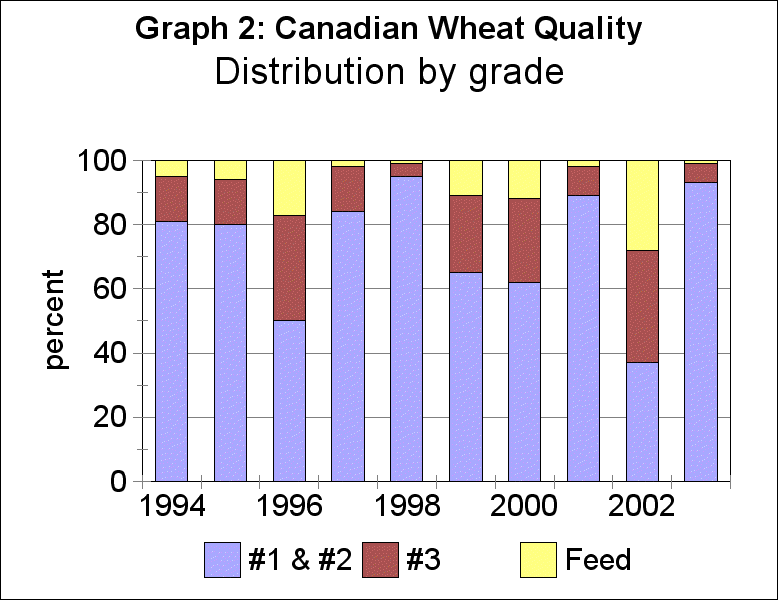 Source: USDA
Conversely in a normal year less than 10 percent is downgraded to Feed. This year a larger proportion of the harvest will be so designated than has been the case for many years. The Saskatchewan figure here is 60 percent.
However, because of the exceptionally high quality of last year’s wheat crop, the 4.3Mt carry-over is likely to be almost entirely top grade wheat. This will almost certainly be a useful supplement to the 24.4M tonnes of generally poor quality wheat harvested this year.
This difficult situation is reflected in the Canadian Wheat Board’s monthly Pool Return Outlooks. In September after the impact of the frost had been assessed the CWB withdrew from the market and more than doubled the premiums expected for higher protein wheats. But the greater uncertainty is over finding unaccustomed markets for significant quantities of non milling Canadian wheat.
The durum situation does not appear to be materially different to that for red spring wheats in terms of crop quality, but as the carryover represents a larger proportion of total supplies, the marketing challenge for the CWB is likely to be less demanding. As in the US the conditions for the earlier winter wheat harvest were reasonable.
David Walker
'phone: 01603 705153
top of page