
US Energy and Fertilizer Costs
- Monday March 21, 2005
This analysis featured in the March 21, 2005 issue of the HGCA's MI Prospects, Volume 7, Number 18
Key points
- US energy and fertilizer prices rising
- Energy and fertilizers cost not high forUS farms in total
- Maize heavy user and soybeans light user
- Rising cost may encourage some acreage shift
- But other factors as important
Recent increases in energy costs are likely to result in higher production costs for US farmers, but the aggregate impact on the industry is likely to be small. US farmers may view soybeans with its lower energy and fertilizer requirements more favourably than maize in this context but other factors will play a bigger role in planting decisions.
US agricultural energy use is diverse. While petroleum products to power cultivation and harvesting machinery are perhaps the most obvious use, natural gas is an important input for nitrogenous fertilizers and heating for indoor livestock and horticultural operations and almost all farmers are significant users of electricity where a static power source is needed.
The US Department of Agriculture (USDA) forecasts US farmers will this year spend US$11.5, US$8.2 and $3.3 billion, respectively on fertilizer, fuel and oil, and electricity(Table 1). Together they account for almost 75 percent of farm expenditures on manufactured inputs, but only about 10 percent of total input expenditures.
continue---------------------------------------------------- Table 1: U.S. farm sector production expenses ---------------------------------------------------- US$ billion 2001 2002 2003 2004F 2005F ---------------------------------------------------- Farm origin inputs 48.6 48.7 52.6 56.4 52.3 Feed 24.8 24.9 26.6 28.3 26.0 Livestock 15.7 14.9 16.7 18.6 16.9 Seed 8.2 8.9 9.3 9.4 9.5 Manufactured inputs 29.4 28.0 28.3 30.4 31.4 Fertilizer & lime 10.3 9.6 10.0 11.0 11.5 Fuels and oils 6.9 6.8 6.8 7.8 8.2 Electricity 3.6 3.3 3.1 3.4 3.3 Pesticides 8.6 8.3 8.4 8.2 8.5 Total interest 13.6 13.0 13.2 13.3 13.4 Other operating 67.3 66.2 65.3 71.7 70.8 Overhead expenses 38.7 37.5 38.3 39.7 41.0 ---------------------------------------------------- TOTAL PRODUCTION 197.7 193.4 197.6 211.4 208.9 ==================================================== Source: USDA Economic Research Service, 02/11/05continued
Crude oil prices have been very volatile over the last twelve months, peaking at about US$55 per barrel in October, declining somewhat subsequently but recently rising to over US$50 again at time of writing. They are more than 60 percent above a year ago level. While natural gas prices spiked last October about 50 percent above current levels, they have not risen significantly on a year on year basis.
The volatility in crude oil prices has been reflected in prices paid for fuel by US farmers(Graph 1). The most recent escalation was not reflected in farm fuel prices last month it almost certainly will this month, in time for spring field work. While natural gas is a major component of nitrogenous fertilizers, the relationship between them does not appear to be particularly close. While fertilizer prices have increased in recent years more quickly than farm inputs generally, they have not shown the extreme volatility of energy items.
continue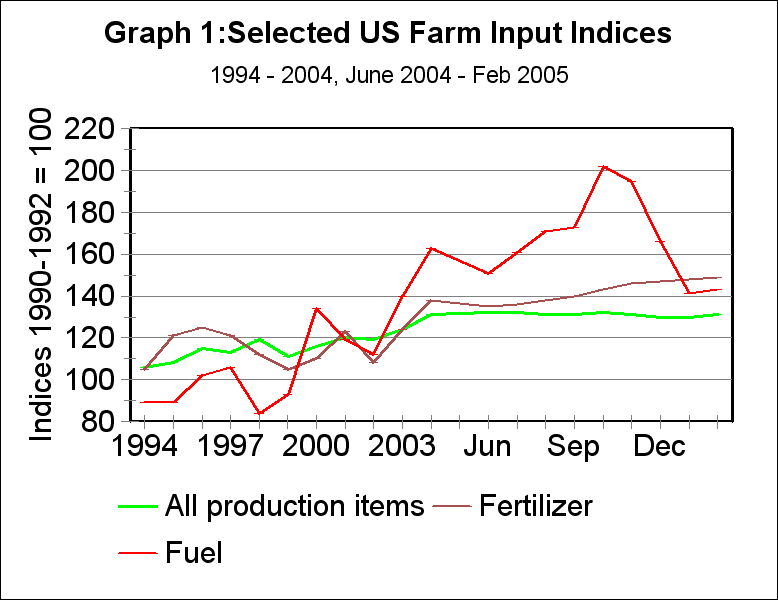 Source: USDA
Given that fuel and fertilizer prices represent less than 10 percent of total costs in US agriculture, even the large increases in costs for these items are likely to have a limited impact. However, costs vary very considerably between farm commodity enterprises and are a significant item for some crops. Higher costs may have an impact when farmers have the option of switching between crops requiring very different levels of fertilizer and fuel inputs.
Maize and Soybeans
Two such crops are maize and soybeans. USDA data suggest that fuel and fertilizer have in the recent past been between 40 and 45 percent of all production costs for maize and between 20 and 25 percent for soybeans. This may partly explain why operating costs are mor ethan twice the costs for soybeans (November USDA forcast, Table 2).
continue
-------------------------------------------------------------
Table 2--Cost of production forecasts for U.S. maize and corn
-------------------------------------------------------------
                                   Corn          Soybeans
Item                           2004    2005    2004    2005
                                      US$ per hectare
-------------------------------------------------------------
Operating costs:
  Seed                        87.55   87.20   68.94   68.64
  Fertilizer                 120.78  124.71   20.93   21.60
  Chemicals                   64.57   65.85   41.69   42.53
  Custom operations           27.72   27.82   15.69   15.74
  Fuel, lube, and electricity 62.15   64.15   23.52   24.29
  Repairs                     36.42   37.09   25.03   25.48
  Other variable expenses      0.54    0.54    0.30    0.30
  Interest,operating capital   2.64    6.60    1.31    3.24
     Total, operating costs  402.38  413.97  197.41  201.81

     Total, alloc. overhead  483.25  488.17  401.96  405.79

     Total costs listed      885.63  902.14  599.37  607.59
-------------------------------------------------------------
Forecasts as of November, 2004. Costs are projected primarily by
applying changes for 2004 and 2005 in indexes of prices paid for
farm inputs to the 2003 production costs.
Source: USDA ERS
continued
These forecasts were made by applying price indices to 2003 survey costs. Subsequent increases in input prices indices suggest fertilizer and energy cost have risen to $36.40 per acre($90 per ha) for maize and more than $8.10 for soybeans($20 per ha).
Further evidence of the increase in production costs comes from the university extension services’ crop budgets which are advising allowances of US30cents per pound for N, 33cents for P and 18 cents for K. Two years ago they were allowing 20, 25, 12cents per pound, respectively for N, P and K.
Over the last three years increases in fuel and fertilizers prices appear to have typically added about $25 per hectare to cost of production for maize, but only about $7 per hectare to the cost of soybean production.
Impact on Plantings?
Last spring the change in cost structure favouring soybeans was almost certainly a contributing factor to the record soybean area, the implication of further increases in costs is less certain this year.
Soybean rust was discovered in the US for the first time last autumn. Although rust can be controlled by fungicides, this means extra costs. There is also an element of uncertainty in the minds of growers that may discourage soybean production.
Further market prospects are less favourable than a year ago. Although prospects have improved in recent weeks, particularly so for soybeans as a result poorer crop prospects in South America, the grain and oilseed supply situation is not tight as it was at this time last year.
In the final analysis, however, field conditions in the spring will have a major impact on what farmers seed. Last year field work got off to a very early start in the US Mid West extending the planting season by at least to weeks. This together with favourable market prospects meant that farmers were encouraged to plant as much as the extended season allowed them to.
US farmers may be more cautious this year than they were last. The very favourable market prospects of last spring were a memory by harvest, which has likely dented the confidence of some. The probability of having to spray for soybean rust may be a concern to many. The likelihood of a return to more normal weather patterns this year suggests spring field work may not progress as smoothly as last year.
In this situation US farmers may be more reticent than they were last year to invest in high priced farm inputs. They may choose to shave cost where possible on acres that are planted, plant less, or switch to crops such as soybeans that require less in the way of high priced energy and fertilizer inputs.
David Walker
'phone: 01603 705153
top of page