
Emerging North American Crop Prospects
- Monday April 18, 2005
This analysis featured in the March 21, 2005 issue of the HGCA's MI Prospects, Volume 7, Number 20
Key points
- Total prospective US area just 0.5% down, at 103.2M ha
- US wheat area smallest since 1972
- US maize area forecast 3% up (+0.8M ha)largest since 1985
- US soyabean area forecast 2% down
- Field conditions currently as favourable as a year ago
Much of North American winter wheat and the major Midwest spring cropping areas lie under a blanket of snow for most of the winter. As the snow retreats into drift banks and the shade of shelter belts, farmers make their final preparations for getting back on the land.
Part of the dawning of spring for farmers is responding to the USDA’s Prospective Plantings survey, or Statistics Canada’s Seeding Intentions survey.
US prospective plantings
The US survey is taken in early March with the results published towards the end of March. It provides an early indication of prospects for crop areas, based on conditions that prevailed at the time of the survey. They only become reality one, two or even three months later by which time farmers plans may have been adjusted to accommodate, or take advantage of field conditions, changes in market outlook, or other unanticipated developments.
The 2005 Prospective Plantings survey indicated that, as of early March, US farmers had lost little enthusiasm with the total prospective area about 103.2M ha, down by less than 0.5% from last year (Table 1). This is despite the much less favourable prospects than a year ago (Table 2).
continue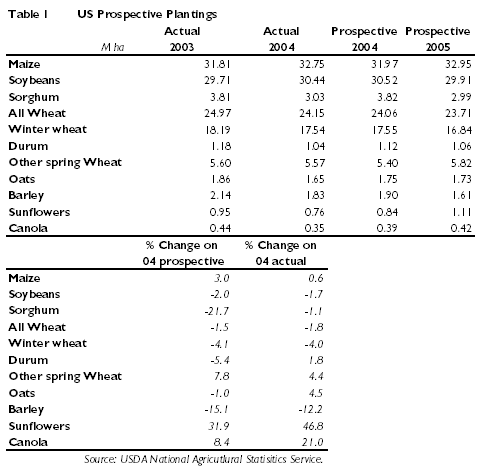 continued
A prospective increase in maize area, up by 3.0%, mainly at the expense of soyabeans, down by 2%, was the most significant survey result. This was a generally anticipated reaction of farmers to a rather wide spectrum of factors including the discovery of Asia soyabean rust in the southern US last autumn (see below), increasing cost of production and less favourable price prospects than a year ago.
Because field conditions were exceptionally favourable last year, farmers actually planted close to 800,000 ha more maize than they indicated they would in the March survey. While a larger maize area could be planted this year, a repeat of equally favourable planting conditions is unlikely. Price prospects appear a little less favourable than they did at the time of the survey and certainly less so than a year ago. But the area sown to maize will almost certainly equal if not exceed last year’s level, and be the largest area since 1985. This may not, however, mean as large a crop as last year as growing conditions were exceptionally favourable last summer.
The soyabean area is down 2.0% from last year’s perspective area. In contrast to maize, last year’s actual area was close to the prospective area. This year's reduction in soyabean area is expected in the more marginal areas in the south where Asian rust is more of a risk and in more northern areas where moisture and temperatures are a greater challenge.
The survey confirmed earlier indications of an actual 4.0% decline in winter wheat area. This is expected to be partly offset by a prospective increase in spring wheat area. But indications are that the wheat area will still be the smallest since 1972 and the continuation of a recent trend (Graph 1).
continue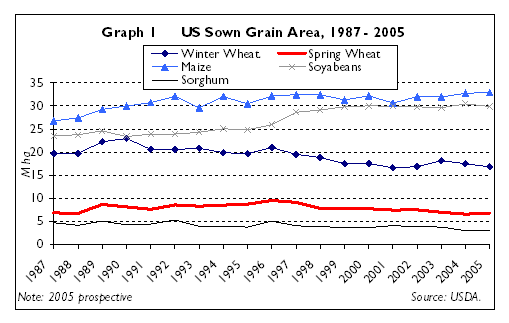 continued
The spring wheat area was reported to be 7.8% above last year’s perspective area and 4.4% above actual plantings last year. The increased area of spring wheat has undoubtedly been encouraged by exceptional premiums for higher quality red spring wheats following widespread frost damage to the Canadian crop last autumn. The increase in the area of spring wheat other than durum is expected to be at the expense of durum, oats and barley.
US crop conditions and prospects
The US winter wheat crop went into dormancy generally in very good condition in the autumn and has emerged this spring almost as well. Assuming average conditions for crop development until harvest, another good US crop can be expected, although a smaller area will offset potential gains in yield.
Planting of the spring crop is ahead of usual but not, as it was last year, exceptionally so. Moisture conditions are also not as favourable as last year. While it is too early to indicate crop prospects from this, conditions will not be as favourable for soyabean plantings as last year where the boundaries of where soyabeans can be grown reach into spring wheat areas. While the USDA has yet to release aggregated crop progress information on maize or soyabeans, state reports suggest that field conditions are at this very early stage as favourable as they were a year ago.
Asian Rust of soyabeans
While Asian rust has been endemic over much of the soyabean growing regions of South America, it was not until last autumn that this fungal disease was found in the US. The current expectation is that soyabeans grown in more southerly US states will be most affected. This disease can be controlled by fungicide application which will, of course, have an impact on profitability of soybean production.
Although almost 90% of soyabean growers were aware of Asian rust only 11% indicated that this was a factor in their planting intentions and of these only 49% planned to reduce area. In the Southeast, one of two regions most at risk, these percentages rose to 29 and 63 % respectively. It would seem, therefore, that the risk of Asian rust was not the main factor in soyabeans planting decisions.
Canadian seeding intentions
Field work, obviously, starts later in Canada because it is further north. Statistics Canada’s Seeding Intentions survey is based on March 31 conditions, with results not being published until late April.
Moisture conditions over most of the Prairies appear to be much more favourable than they were a year ago. In mid March Agriculture Canada, based on economic analysis rather than surveys, forecasts an increase in the sown area in western Canada of spring wheat, durum wheat, oats and flaxseed at the expense of barley, canola, winter wheat and summer fallow. Using trend yields they forecast total grain and oilseed production to fall to 46.5M tonnes from 48.2M tonnes. A smaller but improved quality harvest is expected.
Because of the strength of the Canadian dollar, particularly against the US dollar, price prospects for Canadian farmers appear less favourable relative to a year ago and compared to the five-year average than for their US counterparts (Table 2).
continue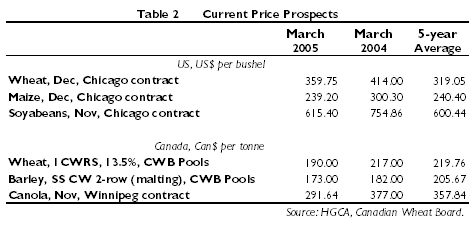 continued
David Walker 01603 705 153
top of page