
The rather narrow base for its international trade means the oilseed rape(OSR) market is very sensitive to Canadian and Australian crop prospects, but within the bounds created by competition from other oilseeds and their products. Both Canada and Australia brand their OSR as canola - varieties bred to contain minimal erucic acid and glucosinolate content, qualities that provide greater consumer acceptability and premiums in some markets. Canada has used genetically modified seed for almost a decade, while Australia is currently reviewing its options.
The Peoples Republic of China, the EU-25, the Indian subcontinent, the US, Mexico, Japan, Canada and Australia in the three years 2002 to 2004 have accounted for more than 98 percent of both production and consumption of OSR, see Table 1. Mexico and Japan accounted for almost 70 percent of imports and Canada and Australia accounted for more than 80 percent of exports. Both the production and consumption of the others are about 80 percent of the world totals. While Japan and Mexico are the only consistently dependent importers of significance, China and EU have in the past been substantial importers in particular years.
continue
Table 1   World Rapeseed Production, Use and Trade
----------------------------------------------------------------
Average 2002 -2004, '000 tonnes
                        Production Imports Exports   Use Ending
                                                         Stocks
----------------------------------------------------------------
Major users
   EU-25                    12,574    198    438  12,194    434
   China; Peoples Republic  11,563    162     37  11,725     84
   Indian sub continent      6,259    632      0   6,775    566
   United States               606    280    248     698     59
Major exporters
   Canada                    6,216    232  3,254   3,157    940
   Australia                 1,354      0    929     444     44
Major importers
   Japan                         1  2,231      0   2,254    189
   Mexico                        0  1,043      0   1,081      8
All Others                     478     26     90     416     40
TOTAL                       39,052  4,804  4,997  38,744  2,365
Distributions
All Others of Total              1%     1%     2%      1%     2%
Majors users of Total            79%                  81%
Major exporters of Total                      84%            42%
Major importers of Total               68%                    8%
----------------------------------------------------------------
Data source: USDA
continued
The Canadian crop is spring seed and Australian crop is autumn seeded. Both are at this time being sown. Crop establishment is more challenging for OSR than for cereals in both countries. The small size of the OSR seed necessitates a fine seed bed and shallow seeding both of which make moisture conditions more critical. Less than favourable moisture condition at seeding can encourage farmers to switch to safer, larger seeded, cereals. In both countries OSR crops are particularly sensitive to hot and dry conditions at flowering. In Canada and surprisingly in some parts of Australia early frosts can result in losses particularly of quality at harvest time.
Canola has been grown in Canada for many years and has well established domestic markets and normally exports between three and four million tonnes, with Japan being the dominant buyer.
After the two drought reduced crops of 2001 and 2002, relatively normal crops in 2003, and a large but frost-damaged crop in 2004, prospects for Canadian canola growers have been any thing but normal in recent years. But supplies of Canadian canola appear to have returned to levels typical of the pre-drought years (Graph 1).
continue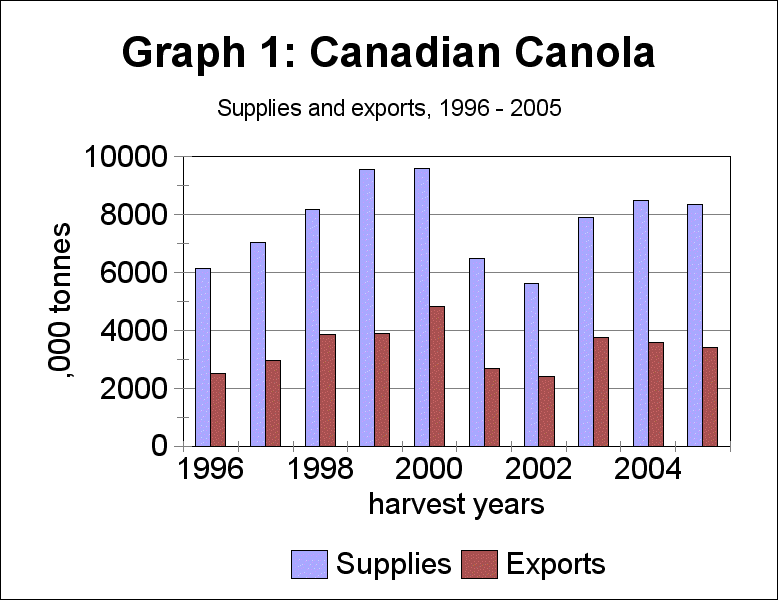 continued
The recent March 31 survey of stocks placed on farm stocks at almost three million tonnes, 97 percent above year earlier levels. But there is considerable uncertainty about the quality of those stocks. Much of the crop was damaged sufficiently to preclude its export and there is no clear indication of how successful the industry has been in using this downgraded seed domestically .
In this context and that of reduced potential profitability of canola relative to other cropping alternatives, farmers in late March indicated they intended to reduce seeding by 5percent from last year’s intentions. As there seems to have been no material change in prospects since then, actually seeding is likely to be close to this.
The matter of delays caused by the need to finish harvesting of the 2004 crop in northern Saskatchewan and Alberta aside, spring seeding has progressed at a normal pace under generally typical conditions. At one stage it seemed that it might be a usually early year but cooler weather has slowed things down some what. On the basis of field conditions and market prices there is no reason to expect the area seeded to canola to vary significantly from the March intention’s survey.
Assuming normal crop development production of about 6.7M tonnes, as projected by Agriculture Canada in April seems a reasonable expectation. This decline in output will be mostly offset by a larger carryover. Total supplies are projected at 8.35M tonnes slight below this year.
Just as the proportion of the crop damaged by last August’s frost is not known, so is the quantity contributing to total supplies. Theories abound on this. With the European market closed to Canadian canola, outlets for off grade canola are very limited and since harvest prices have been very heavily discounted. The quantity remaining in the system may be quite substantial if farmers are purposefully holding off grade canola over in the hope of better sales opportunity assuming the 2005 crop will be of more usual quality.
Canola is a relatively new crop to Australian with production growing very rapidly during the 1990's. Over the last five years seeded area has declined gradually as some areas where it was initially grown have proved unsuitable and crop disease challenges have merged, Graph 2. The drought crop of 2002 apart, Australia has exported more than one million tonnes a year with a greater variety of destinations than Canada.
continue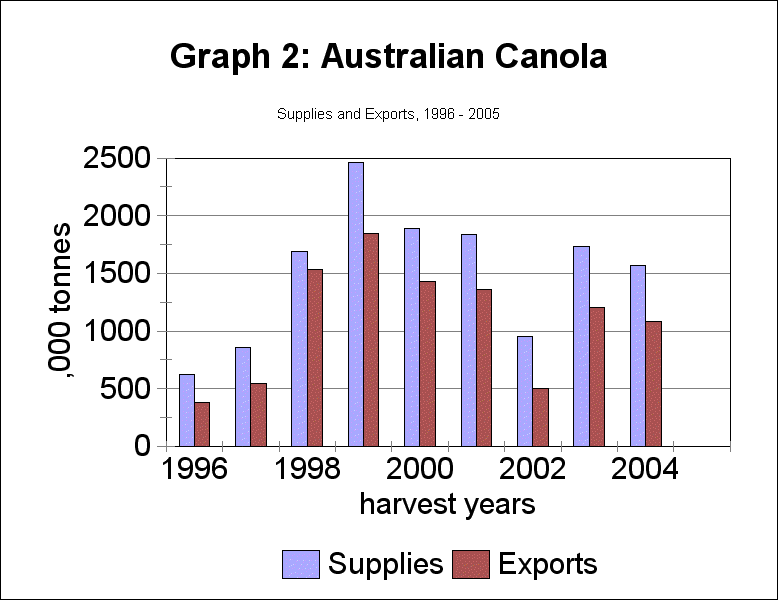 continued
Concerns are being expressed about soil moisture conditions for this year’s canola crop which is about to be seeded. Trade sources in April suggested an area of about 1,067 hectares. This is about ten percent less than harvested last year and would be the fifth year seeded area has declined. And, it is possible that this area will be further reduced. Western Australia apart, conditions are currently reported to be hotter and drier than usual over the major canola producing areas of Australia.
It seems likely therefore that Australian output will decline again. And, as Australia does not have significant carryover stocks, this will be reflected quite directly in exportable supplies and exports.
It would seem that both Canada and Australia will have somewhat lower volumes of canola to export next season, although there is more than usual uncertainty over the Canadian situation on account of quality considerations.
There is no reason not to expect Australian canola supplies to find export markets, albeit at lower prices than last year if international vegetable oilseed markets remain as they are now lower than they were last year. Past experience suggests that Canadian farmers are cautious when marketing canola following a decline in price. Agriculture Canada predicts a small decline in canola exports, possibly for that reason.
David Walker 01603 705 153