
Ocean Freight Update
- Monday August 22, 2005
This analysis featured in the August 22, 2005 issue of the HGCA's MI Prospects, Volume 8, Number 4
Key points
- Ocean freight rates peaked about 18 months ago
- Moving erratically lower
- Demand is being driven largely by Chinese investment
- Increases in vessel supply exceeds potential long term cargo growth
While ocean freight rates are still high in a historic perspective, a rather erratic downward trend is emerging from the highs in the spring of 2004. Anticipated growth in capacity of the ocean dry bulk fleet more than matches prospects for sustainable demand for cargoes. But higher ocean freight rates point toward a more geographically segmented international grain market.
The rapid and very substantial increase in ocean freight rates during 2003 and early 2004 have had a very material impact on international grain trade. Prior to that time ocean freight costs were typically a relatively small and stable component of the cost of trading grain internationally. For instance between 1998 and 2002 the rate for heavy grains between US Gulf ports and Rotterdam were within an US$10.00 to US$15.00 per tonne range and generally less than 25 percent of the value of the grain and usually very much below that level.
In contrast over the last 18 months, rates on this route rose to more than US$40 per tonne, declined back to less than US$30, only to rise gain almost to their previous high and returned recently to under US$30 again(Graph 1).
continue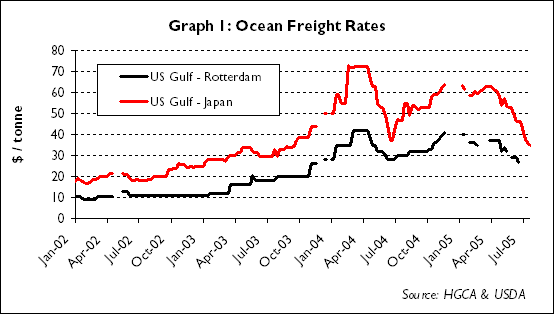 continued
Grains and oilseeds represent less than 15 percent of the world dry bulk cargo market. They have also been a relatively stable portion of this trade. The seesaw action in this sector is attributed to perceptions about demand conditions for other dry bulk commodities. Particularly important is the demand for iron ore shipments and in turn for steel resulting from economic conditions in China.
China now accounts for approaching one third of world steel production and almost all the growth in output. During the 12 months to May 2005 world steel production rose by about 35M tonnes to 455M tonnes, while Chinese steel production rose by about 33M tonnes to 135M tonnes. Iron ore and other steel related products accounts for almost 50 percent of dry bulk shipments.
Growth in demand for dry bulk cargoes is, therefore, very dependent on economic developments and capital investment in China which tends to be very uncertain because of the central nature of planning in that country. Short term demand for dry bulk cargoes is, therefore, next to impossible to anticipate.
The supply side conditions in the ocean freight market are, however, very much more certain. Following the dramatic rise in freight rates in 2003, the rate at which vessel tonnage were scrapped (typically about 5M tonnes per year), declined rapidly to less than 1M tonnes.
It has, of course, taken rather longer for the shipbuilding industry to increase the supply of new vessels. Before the rise in freight rates, annual additions to the dry freight fleet totalled about 13M tonnes. The increase in freight rates was seemingly, to some degree, anticipated by ship owners who ordered over 22M tonnes of dry bulk capacity in 2002. In 2003 new orders amounted to about 27M tonnes and probably represents as much as the shipbuilding industry is in a position to deliver.
Prior to the rise in freight rates, the increase in the dry bulk fleet, new vessels less scrapped tonnage, was typically about 8M tonnes, or four percent. With freight rates that provide an unequivocal incentive to invest in new vessels, this figure has probably been tripled to something more than ten percent. This clearly exceeds even the most optimistic projections for sustainable growth in the world economy on which demand for dry bulk cargoes ultimately depend.
This suggests ocean freight rates will surely tend to decline as long as the current rate of growth in dry bulk fleet continues to add to the supply faster than sustainable global growth in demand. This is not to suggest that the recent and substantial decline in ocean freight rates reflects this. It is more likely a result in changes in perceptions as to the prospects for the Chinese economy and its plans for capital investment. While rates may rise from current levels, any advance is unlikely to be sustained or to result in rates seen in early 2004.
At the same time freight rates are unlikely to return to the level that typically prevailed prior to 2003. With substantial increases in operating costs, particularly for fuel and for meeting increasingly stringent environmental requirements, the incentive threshold for investment has been raised. Indeed the volatility of freight rates is a disincentive in itself.
Implications for the Trade of Grain
In all probability the dramatic increase in prices may have had a limit impact on the amount of grain traded, although it almost certainly had an impact on prices received and paid by various participants in grain marketing channels. It might be reasonable to suppose that those producers most distant from their customers, and conversely those customers most distant from producers, have been most adversely affected by these increases in transportation cost.
But the conditions at ports of loading and discharge, availability of cargoes prior to loading and following discharge and other such commercial considerations can have a material impact on voyage rates. Thus the proximity advantage of Argentina over Canada in the Brazil market may be largely offset by the abundance of soyabean cargoes available at Brazilian ports for shipments north (Graph 2).
continue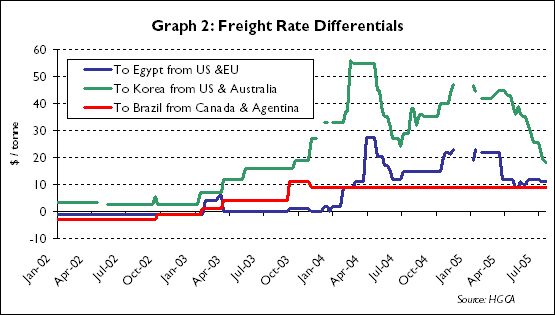 continued
In situations where such grain, or other dry bulk back-haul business opportunities are limited as may be the case with Egypt, distance becomes the dominant determinant placing nearby sources such as the EU at an increased advantage to more distant US sources.
The very substantial differentials that have developed at times over the last 18 months have been associated with the very high freight rates that are most unlikely to be sustained. But they do draw attention to the probability that economically significant differentials will remain. This points to the possibility that international grain markets are likely to be increasingly geographically segmented in the future.
David Walker 001 780 434 7615
top of page