
Canadian Crop Conditions
- Monday September 5, 2005
This analysis featured in the September 5, 2005 issue of the HGCA's MI Prospects, Volume 8, Number 5
Key points
- Good yields expected for most crops
- But export prospects dependent on improved quality and favourable harvest weather
- Specially for malting barley
With mostly good crop prospects, Canada will have abundant supplies of most grains and oilseeds this season. However, following last year’s poor quality crop, supplies of export quality grain are likely to be more restricted particularly if harvest weather is not favourable.
No two years are the same when it comes to crop development on the Canadian prairies or anywhere else for that matter. A year ago a late crop and an early frost resulted in a high yielding crop of very ordinary quality. The previous year hot and dry conditions in July and August resulted in a quality crop with very ordinary yields.
This year mositure and temperature conditions have generally been favourable for crop quality and quantity. Cumulated precipitation for the growing season, critical for crop development, has been above average across much of the Prairies (Map 1). Only in eastern Manitoba moisture conditions have been unfavourable - excessive moisture prevented crops from being sown and caused the drowning out of others early in the season, while weather has turned very dry since mid-July.
continue continued
This situation has received much publicity, but it is not of great importance in a Prairie-wide context for the major field crops. Temperature conditions have also been relatively favourable for crop development with perhaps cooler than normal conditions early in the growing season, and, importantly temperatures not being much above average anywhere, causing prematurely ripening of crops during July (Map 2).
continue continued
The expectation that the 2005 crop would sit somewhere between the extremes of the previous two years was confirmed by Statistics Canada’s July 31 field crop production estimate. Total output of major grains and oilseeds was placed at 64.6Mt, compared to 66.2Mt last year and 60.3Mt the previous year. The report did not contain any major surprises for specific crops.
Spring wheat yields were estimated to be only 2.6% below last year’s record, but with a continuing decline in the sown area, an estimated crop of 17.8Mt will not be a big crop by Canadian standards (Graph 1). In contrast, farmers again planted a relatively large area to durum wheat despite a significant increase in carry-over stocks. The durum wheat crop, estimated at 5.1Mt, is the largest since 2000. The relatively small winter wheat crop (1.8Mt), grown mainly Ontario, suffered from dry early summer conditions in eastern Canada.
continue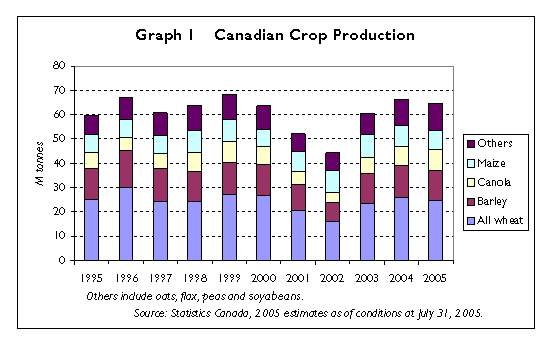 continued
Barley production was estimated at 12.4Mt with a smaller area and reduced yields combining to contribute to the 6.3% decline. Oats production, estimated at 3.7Mt was up about 1%, reflecting a larger sown area.
Canola production, estimated at 8.3Mt, was 7.7% above 2004 and the second largest crop ever. The area sown to canola was only up by about 2% but canola yields in 2004 were devastated over a wide area by the August frost. Flaxseed production has more than doubled to 1.0Mt after being decimated by the frost last year.
While dry pea production is probably still in an upward trend, production this year of 3.2Mt is 3.4% below last year with a reduction in planted area probably a reaction to increasing carry-over stocks.
At the time of the survey most crops were in the early filling stage with some more advanced and some less, depending on the type of crop and latitude. Since the date of the estimate, weather conditions have been relatively damp and cool. This will have had positive implications for some crops but may have delayed maturity somewhat. With the window of potential for significant frost damage down to about three weeks in mid-September, there have been no reports of meaningful damage.
Canadian market prospects for the coming crop year are tied more closely than usual to harvest quality. Last year export quality grain was in short supply despite a generally very large harvest. While in a statistical context Canada appears to have abundant supplies of almost all grains and oilseeds, export prospects are very dependent on harvesting conditions conducive to quality over the next month.
Looking forward prospects for the 2006 are, at this very early stage, as favourable as they have been for some years. With the end of the growing season and current crop demand for moisture complete, top and subsoil moisture is reported widely across the Prairies to be at or close to capacity. This is the first time since before the 2001-2002 drought that the widespread need for post harvest moisture replenishment has not been evident.
Of particular interest in a UK context is the malting barley situation as Canada is a major if not dominant player in international markets. As always prior to harvest, Canada has an abundant potential supply of malting barley. And as always the actual supply will be determined by harvest weather. Last year supplies of malting barley were restricted in the first instance by a severe August frost and secondarily by poor harvest conditions resulting in part from the lateness of the crop. As a consequence exports of malt and malting barley from the 2004 crop were limited and even domestic maltsters have been working on a hand to mouth basis prior to harvest.
Quality prospects for the two-row malting barley harvest, generally in the western Prairies, appeared very favourable until mid-August when two major weather systems resulted in heavy and widespread rain. While damage to the crop was probably not significant, it was a timely reminder that nothing is certain about malting barley supplies until the crop is under cover which is at least four weeks away. In the eastern Prairies the situation for six-row barley, which when used for malting is used almost entirely in North America, is already difficult. Crop abandonment due to flooding is likely to be more serious for late sown barley than other crops. The incidence of fusarium what affects six-row barley in humid conditions is also expected this year to be more widespread than usual.
In eastern Canada, particularly southwest Ontario, which is something of a cross border geographic extension of the US corn belt, hot and dry conditions during July, when maize was pollinating, have reduced maize production potential and yields below those of last year. A crop of 8.2Mt is projected, 6.8% below last year.
David Walker 001 780 434 7615
top of page