
North American Crop Update
- Monday November 14, 2005
This analysis featured in the November 15, 2005 issue of the HGCA's MI Prospects, Volume 8, Number 10
The US harvested a relatively small wheat crop, another large maize crop but a smaller soyabean crop. The Canadian harvest was a relatively large one, but quality was a little disappointing.
US Wheat
US wheat production declined again this year with output estimated at 57.1Mt, 3% below a year ago (Table 1). The area sown to winter wheat was the smallest in more than 20 years and spring wheat (other than durum) yields were at the bottom end of the normal, i.e. non-drought year, range. The decline in winter wheat area is a continuing trend. The poor yield of other spring wheats came as a surprise in the September production estimate. The crop had been reported in relatively good condition throughout the growing season. The USDA’s National Agricultural Statistics Service commented that hot and dry weather during July accelerated development and rushed heading ahead of normal.
continue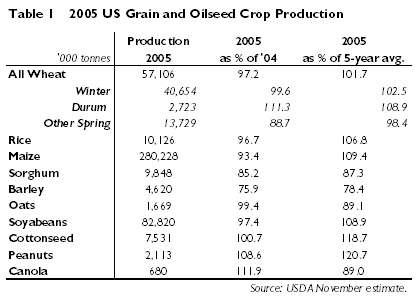 continued
With reduced production and a smaller carry-in, US wheat supplies, at nearly 74Mt, are down 2% from last year. Apart from the recovery following the '02 drought, US wheat supplies have declined every year since 1998 (Graph 1). Given limited wheat supplies, the USDA is projecting a 6% decline in exports this year. Five months into the ‘05/06 crop year, wheat exports are 9% below a year ago. Futures prices are generally 15 to 30 cents / bushel above year-ago levels, (depending on the class of wheat).
continue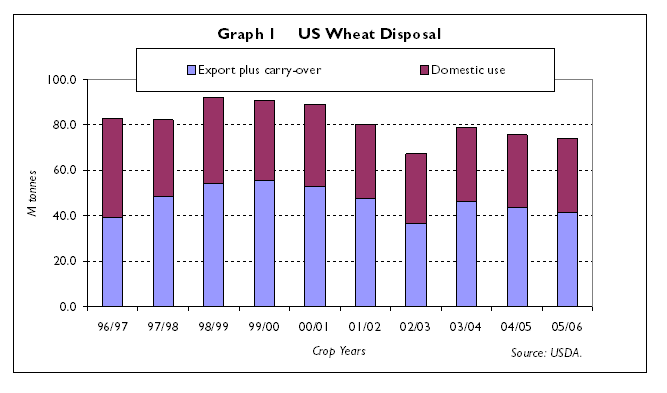 continued
At early November, the US winter wheat crop was more than 95% planted and about 84% emerged, which is slightly ahead of normal. The crop is reported to be in normal condition with about 57% of the crop in good or excellent condition. Over the last five years this statistic has varied from 45 to 75% at this time. The condition of the US winter wheat crop prior to dormancy is, however, not a good indicator of eventual harvest prospects.
US maize
Supplies of US maize appear more abundant for a second consecutive year than they have done for many years before. This is the result of increased carry-over from last year’s record output and a very respectable ‘05 crop. While crops in and around Illinois suffered from an unusually hot and dry July, the impact on yields was limited and less severe than anticipated. The USDA currently estimates the US crop at 280Mt, 6.6% below the truly exceptional ‘04 crop. This, together with a carry-over of 54Mt, put total supplies at about 334Mt. The USDA is currently projecting domestic consumption of 224Mt, about 1% less than last year with continued growth in use for ethanol production. This is up 13%, largely offsetting an almost 5% decline in feed-use. Ending-stocks are expected to rise by nearly 10% and exports are projected at 51Mt, 10% above last year.
After two months into the crop year, exports are running 4% below a year ago. As a result of this rather disappointing start to the season, US futures markets have declined steadily in recent weeks with the December futures, at the time of writing, below the US$2.00 / bushel level and almost down to year-ago levels. Current prices are the equivalent of about £44/t, compared to £42 /t a year ago when the US dollar was stronger. Through the winter months, market prices will continue to reflect export prospects, particularly as they may be affected by perspective southern hemisphere feed grain output. As the planting season approaches, the ‘06 area will start to influence prices with fertiliser costs being an important determinant.
US soyabeans
With a 4% smaller area and yield about 1% higher, US soyabean production is estimated at 82.8Mt and 2.5% below last year. Larger carry-in stocks have more than offset this, increasing supplies by almost 2%. The USDA projects domestic use virtually unchanged, exports down by 2.5% and carry-out up by about a third. After two months into the season, US exports are running 20% above year-ago levels and outstanding sales even further ahead.
Canada
Following an exceptionally large but poor quality crop in ‘04, interest in Canada has been focussed on harvest weather conditions and quality implications. Harvesting is now virtually complete although there are more than the usual number of weather interruptions. The crop is certainly of better quality than last year's, but is not of the high quality that was hoped for to complement carry-in stocks which are perceived to be of low quality. It is, however, another relatively large crop. Statistics Canada estimates a total Canadian crop of 62.6Mt, compared with 63.6Mt last year and a ten-year average of 59.2Mt. Total supplies of Canadian grains and oilseeds have fully recovered from the drought in ‘01 and ’02.
Total wheat production is estimated at 25.5Mt, 1% below a year ago with an 8% increase in durum more than offset by other classes of wheat (Table 2). Total supplies of wheat are little changed from last year with very favourable prospects for milling quality wheat but the converse for feed grades. Assuming sufficient quality wheat is available, Agriculture and Agrifood Canada (AAFC) is projecting a 17% increase in exports. With substantial increases in carry-over and output, durum supplies are 17% above last year. AAC is projecting more of the increase ending up as carry-over rather than as exports. Canada now dominates the international durum market and prospects for Canadian exports are very dependent on North African crop prospects.
continue continued
Barley production is down 8% but, with an increase in carry-over stocks, total supplies are up slightly. AAFC is projecting a 34% recovery in exports to the level of ‘03-‘04. While the crop is believed to be of below average quality, enough malting barley quality is expected for Canada’s traditional markets. Given this year’s lower world barley production, Canadian feed barley is expected to find export markets.
With a larger sown area and record yields, canola production is estimated to have increased by almost 10% to 8.5Mt. Total supplies are estimated to be more than 20% above last year. AAFC forecasts that much of the increase in supplies will be carried over to next year, with end-season stocks increasing to a record 2.5Mt.
David Walker 001 780 434 7615
top of page