
Emerging US Supply Prospects
- Monday April 19, 2006
This analysis featured in the April 19, 2006 issue of the HGCA's MI Prospects, Volume 8, Number 20
Key points
- Reduced area and below average yields for wheat
- Smaller maize area
- But larger soyabean area
- US wheat and maize exports likely to be lower in ‘06/07
- While US soyabean exports likely to rise
Early crop progress reports and prospective planting survey results suggest the long-term trend of declining US wheat supplies will continue for ‘06/07. If the actual area planted to maize is as indicated by the prospective planting survey it will require favourable crop development to sustain increasing domestic consumption and current levels of exports. This survey also suggests that supplies of soyabeans will be more abundant.
With the publication of the results of the USDA Prospective Plantings survey and the start of the weekly USDA crop progress reports, the first tentative indications of probable US ‘06 grain and oilseed production start to emerge. While there is no reason to doubt the accuracy of either source of information, it is as well to keep in mind that they reflect the situation at a specific point in time. The farm survey of Prospective Plantings was undertaken during the first two weeks of March, which is at least a month before much planting actually begins. The first crop progress reports reflected conditions on April 9, some two weeks after the relieving rains in the southern part of the US winter wheat belt which may not be reflected fully.
Prospective planting report - US farmers indicated in early March that they planned to plant about 125M ha to major crops, similar to the area planted in ’06, but 1.5% less than they planned at this time last year (Table 1). Of this total about half of this is maize and soyabeans and almost 20% wheat. This was prior to general rains which began to reverse worsening drought conditions. Hence, farmers may have been more conservative in their plans at that time, preferring more drought resistant crops such as wheat and sorghum to more drought prone crops like maize and soyabeans.
continue continued
The ‘06 prospective area for maize was placed at 31.6M ha, 4.6% and 1.5M ha less than actually planted last year. The area for soyabeans was a record 31.1M ha, 6.6% and 1.9M ha above last year. While most of this change reflects farmers’ decision to substitute soyabeans for maize, there also seems to be an increase in soyabean production in the spring wheat growing states, particularly North Dakota. Prices for both maize and soyabeans are lower than a year ago and projected carry-over for both crops is expected to increase. However, soyabean production costs have not risen to the same degree as those for maize and the extent of the swing in plantings was larger than expected.
The report confirmed US winter area, sown last autumn, at 16.8M ha and although 2.4% greater than last year, the long-term trend of relatively low winter wheat areas continues (Graph 1). Prospective spring wheat area is placed at 6.4Mha compared with 6.9Mha last year. This decline is a result of a one third cut in durum area to about 0.74M ha which would be the lowest durum area since 1961. Total winter and spring US prospective wheat area, at 23.1M ha, is the lowest since 1972. Looking ahead as to what may actually be planted, changes in market prospects and energy and fertiliser costs are the most critical economic factors. Actual plantings are also sensitive to field conditions. Wet conditions resulting in late planting have in past years resulted in a bigger area being sown to soyabeans than planned, at the expense of maize.
continue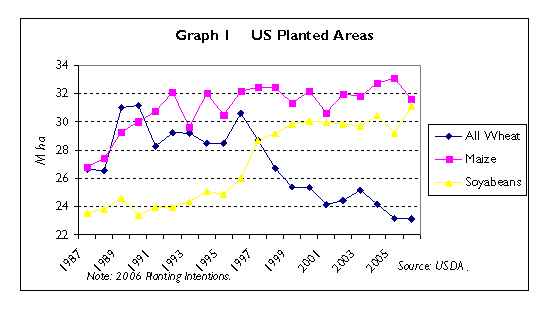 continued
The first USDA Crop Progress report, monitoring condition existing on April 2 ‘06, confirmed what had been increasingly apparent over the winter months. The condition of wheat crops in Texas, Oklahoma and to a lesser degree in Kansas had deteriorated to the degree that they had had a major impact on the overall conditions even though conditions elsewhere are generally very satisfactory. On a national basis only 38% of reports were for good or excellent crop condition, compared to 68% at this time last year, and 52% (but declining) at the end of November ‘05. For the three states suffering from the drought, Texas, Oklahoma and Kansas, only 7, 11 and 38% of reports were, respectively, of good and excellent conditions.
Planting conditions in the autumn were favourable in all areas except Texas, but drought conditions spread through Oklahoma and much of Kansas. Compounding the impact of a lack of rain or snow was much higher than normal winter temperatures. Crops were stressed over a wide area as evident from the USDA first crop progress reports. What is more difficult to gauge is the potential for recovery of stressed crops which are generally two months away from harvest. Rain since mid-March has alleviated drought symptoms, although higher than normal rainfall will be needed to replenish sub soil deficits and to met the increasing moisture needs of crops as they mature.
Previous seasons when US winter wheat crops were in poor spring condition do not provide an indication of the recovery potential for this year’s crop. But it seems that at least in Kansas the extent of non reversible damage may be limited (Graph 2). Crop conditions improved quite markedly in late March since the general rains and improved again during the first week in April. The same improvement was not evident in Texas & Oklahoma.
continue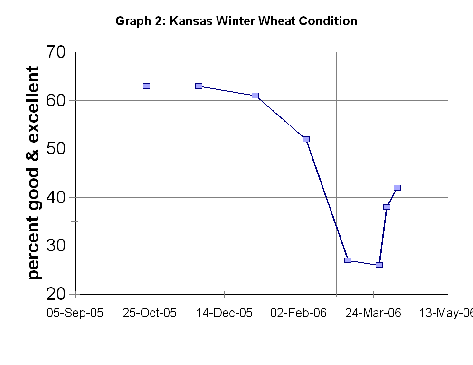 continued
Market implications - Between the beginning of December and mid-March new crop hard red winter wheat prices increased by about 30% as drought conditions spread. Perhaps half that advance was lost as a result of the significant and widespread rains later in March. More recently prices have advanced again as rains have not been sufficient to sustain continued improvement in conditions. The first formal USDA supply and demand projections, published next month, will surely show a tighter wheat supply situation than the guidance figures provided in February which were relatively neutral in their market implications. The planted area, harvested area and yield used all now look optimistic, with the implication that there will be a further decline in US wheat exports in ‘06/07.
For maize the area used in the February projection was about 5% higher than the prospective plantings data. Favourable crop development and good yields are therefore required, if increased US domestic consumption and current levels of export are to be sustained. The larger soyabean area suggests latitude for increased US exports providing normal crop development. Markets reacted positively to the prospect of a smaller maize area, setting contract highs for new crop maize. Soyabean markets declined testing their lows of last December.
David Walker 001 780 434 7615
top of page