
North American Crop Update
- Monday June 26, 2006
This analysis featured in the June 26 2006 issue of the HGCA's MI Prospects, Volume 8, Number 24
Key points
- US winter wheat crop estimated at 34.3Mt, 16% below last year
- US spring crop rating slipping in June
- US spring wheat of greater interest , as HRW wheat crop suggests short supply of higher quality wheats
- Canadian farmers planted more wheat, canola and field peas than earlier indicated
The US winter wheat crop is quite as poor as was earlier expected and there has been slippage in the condition of the spring wheat crop in recent weeks. Spring sown maize and soyabean crops, however, are off to an excellent start. Western Canadian crops have also had a good start, with improved market prospects encouraging farmers to sow more spring wheat, canola and field peas and leave less land fallow than earlier indicated.
US Winter Wheat
As of June 18 harvesting of hard red winter wheats (HRW) on the southern plans is 66, 94 and 53% complete in Texas, Oklahoma and Kansas, respectively, which is above average and a reflection of poor conditions. Soft red winter wheat crops (SRW) in the major Midwest producing states are generally less than a month away from harvest. Only white winter wheat (WWW) in the Pacific North West and spring sown crops are sufficiently immature to be affected by weather conditions. Hence, winter wheat harvest prospects are now fairly firm.
The USDA’s June estimate of winter wheat production, which included objective field surveying, places overall yield at 2.72 t / ha, a harvested area of 12.6M ha and production of 34.3Mt. Not only is this 16% below last year’s output, but 4% below the May production forecast. US winter wheat crops generally emerged last autumn in good to excellent condition. A warm winter in the southern plains meant, however, that HRW wheats came out of dormancy very early and exaggerated the impact of well below normal winter precipitation. But by mid-March, when the first significant rain since sowing was received over much of the HRW wheat production area, yield potential had been lost and subsequent rainfall was not sufficient to maintain the maturing crops.
In contrast SRW and WWW wheat and even HRW grown in more northerly regions are in much better condition. Overall, however, the US winter wheat crop was in ordinary condition early this spring and has deteriorated further (Graph 1). The percentage of the crop rated in good or excellent condition has been lower than that for the drought-reduced 2002 crop. Since there has not been further rating deterioration since early June, major further downward revision in subsequent USDA production forecasts become more unlikely.
continue continued
US Spring sown Crops
US spring wheat planting was relatively slow in starting but soon picked up momentum and ended up with a relatively early finish. Emergence was delayed for early sown crops but overall the crop was planted in good time. In early June the crop rating was above average but there has been some slippage more recently. The condition of the US spring wheat crop, and particularly the hard red spring wheat (HRS), is of greater than usual interest because of the HRW wheat crop and the prospect of short supplies of higher quality wheats.
Planting of the US maize crop progressed at a faster than average rate in the main production area of the US Midwest. This has resulted in crop emergence slightly earlier than usual, but a week behind the exceptional 2004 crop. The percentage of the crop rated as good or excellent by the USDA in mid-June, however, almost matches that of the 2004 crop which yielded 10.0 t / ha. The difference between high and low yield scenarios is very significant in the context of the US being able to meet increasing domestic and export demand, particularly with regards to fuel ethanol production. A weather market has developed earlier than usual and is likely to intensify rather than diminish during the critical period for crop development during July.
Planting of the US soyabean crop, which follows maize, also progressed at an above average pace and crop emergence has also been earlier than average, particularly in the US Midwest (Graph 2). Early crop ratings by the USDA are towards the top end of the range of conditions in recent years, but the critical period in crop development for US soyabeans is not until August.
continue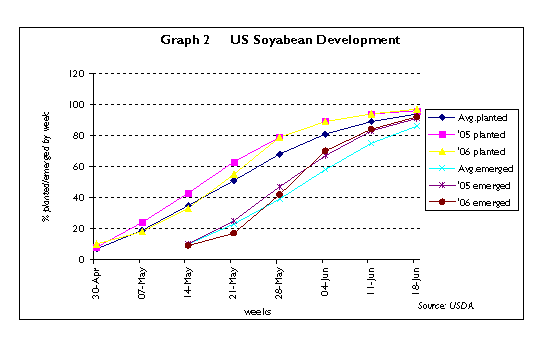 continued
Western Canadian Crops
Spring sown crops dominate the Prairies. Only about 0.5M ha, or 2% of total sown area is winter wheat. The balance is planted between late April and early June. Statistics Canada preliminary estimate of sown area indicates Canadian farmers planted about 27.1M ha, 3% more than in 2005 and earlier than intended (Table 1). A combination of improved market prospects and generally favourable field conditions for sowing encouraged farmers to plant larger areas to spring wheat and canola than was signified in the March Seeding Intentions Survey.
continue continued
Spring wheat area is estimated as 8.3M ha, 3% above intentions, 14% above 2005 and the largest area since 2001. As in the US, the Canadian wheat area has been declining in recent years, but with the US HRW wheat crop in poor condition, opportunities were evident for Canadian HRS. Durum area is, however, down 26% from last year. Canada dominates this sector of the wheat markets and a succession of large Canadian crops has resulted in a cumulation of excessive Canadian carry-over stocks.
Canola area is estimated at 5.4M ha, 15% above intentions and only 1% less than in 2005. Supplies and potential supplies of Canadian canola are very large but canola is moving off farms at a record pace and biofuel use expectations are evident. Also, soil moisture conditions were favourable for planting canola. Field pea area is a record 1.4M ha, up 2% from intentions and 4% from last yea. This is a relatively inexpensive crop to grow when energy and fertiliser prices are high and Canadian exports continue at a record pace. Oats area is up 1% from intentions and 19% from 2005. The US market for heavy oats continues to pay an attractive premium above feed values. Barley area is down 3% from intentions and 8% from 2005, since premiums for malting barley in recent years have not been great. The 21% decline in summer fallow area from the seeding intentions survey reflects improved market prospects and favourable field conditions.
David Walker 001 780 434 7615
top of page