
Canadian Crop Update
- Tuesday September 18, 2007
This analysis featured in the eptember 18, 2007 issue of the HGCA's MI Prospects, Volume 10, Issue 6
Key Points
Well above average temperatures in July particularly in the southern Prairies cut into yield potential of the Canadian crop which prior to this was favourable. The seeded area has, however, had a larger impact on output with a shift from wheat to barley, oats and canola on the Prairies and from maize to soyabeans in eastern Canada.
Statistics Canada's first forecast for 2007 field crop production placed output of the eight major crops at 67Mt, slightly less than the revised 2006 output. This estimate was based on a grower survey in late July and, therefore, reflected the impact of warmer than average weather during July. Conditions and crop development on the Prairies were in many respects similar to those in 2006. Crops were generally sown into good to excellent moisture and in some areas sowing was delayed by wet field conditions. Early prospects for very favourable yields were, however, stymied by hotter than average conditions during July, particularly in southern Alberta and southern Saskatchewan (see, map). Spring wheat and durum yields were most adversely affected. Other crops, generally grown more widely outside this area, were less affected and in some instances yield estimates are higher this year than last.
continue continued
Wheat - Although disappointing, the spring wheat yields were in aggregate slightly above the ten-year average, while the sown wheat area was the lowest since 1971. Estimated production of 14.1Mt is 24% below last year and 23% below the ten-year average. Estimated durum output at 3.6Mt is up 6% but this follows a 22% cut in area last year and is also 23% below a ten-year average. Exports of spring wheat and durum of 10.5M and 3.3Mt, are respectively 30 and 26% below last year, with ending stocks projected declining to pipe line supplies.
continue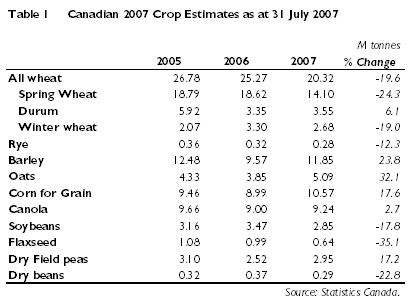 continued
In retrospect it seems illogical that Prairie farmers would choose to reduce wheat production as recently as April and May, when prices were on the bench mark Chicago futures market exceeded US$5.00 /bu and were more than 25% above year earlier levels. There are two possible explanations - as Prairie wheat is largely pool priced, the market signals are muted and the appreciation of the Canadian dollar has in recent years tended to depress Canadian grain prices. The Canadian Wheat Board’s (CWB) August 23 2007/08 pool return outlook (PRO) for 1CW Red Spring wheat, 13.5% protein, at tide water was Can$258 /t (£121) compared to $214 (£100.50) last year. For 1CWA durum it was Can$321 /t (£150.70) compared to this year’s $221.00(£103.75).
Feed grains - Statistics Canada estimated barley, oats and maize production at 11.9M, 5.1M and 10.6Mt, respectively and 24, 32 and 18% above 2006 output. With a reduced area sown to barley in 2006 a tight supply situation developed. Prices were supported over the winter months at incentive levels by the cost of importing US maize and by limited supplies for malting selection and export. Supplies will improve this year. However, with harvest still underway, any assessment of potential malting barley supply is speculative. In the south and east where harvest is complete quality is not a problem. But rain has delayed harvesting the bulk of the crop further north and quality may have slipped. Also complicating assessment of malting prospects is the export sale of 0.8Mt of feed barley and an anticipated transportation challenge (see below).
For oats, exports to the US increased sharply to fill demand left by the absence of Scandinavian oat exports to the US south east. This year’s oats production is the largest in at least 25 years. Although exports are expected to match last year’s record, oats may be the only grain for which ending stocks will increase. The CWB’s August 2007/08 PRO’s for special select malting and feed barley were, respectively, Can$262 (£123) and Can$217 (£102) /t. Last year’s PROs were virtually at par at about Can$200 /t (£94).
A record of 10.6Mt maize crop is anticipated mainly as a result of farmers shifting area from soyabeans to maize. Conditions have been relatively dry in Ontario and Quebec, the major production area, which will to some degree limit the size of the 2007 harvest. Canadian consumption of grain for fuel ethanol production is limited, at about 1.35Mt of maize in eastern Canada and 0.79Mt of wheat in western Canada.
Oilseeds - Canola production is estimated to be up 3% at 9.2Mt, and only 4% lower than the record 2005 crop. Canola yields are somewhat lower than last year but still above the ten-year average. They are generally perceived to be very susceptible to hot, dry conditions, but the bulk of the crop is grown outside the area which suffered most in July.
The increase in the Canadian canola area this spring, when oilseed prospects elsewhere did not appear very positive, can probably be attributed to the very significant growth in Canadian exports of canola and products (Graph 1). However, the two specific factors mainly responsible for the growth may not enhance exports this year. Demand for Canadian canola for European biodiesel production was sudden and seemingly short-lived. The equivalent of 0.8Mt of canola was exported as canola oil for this purpose over a 12-month period. Also, the 2006 Australian drought eliminated competition for Canada in the Pacific markets and instead created a market with Australia importing about 50,000t of Canadian canola. However, given improved crop prospects, Australian canola is expected to back in international markets by the end of the calendar year. The anticipated growth in US demand, particularly for fast foods, may not come quickly enough to fill these two gaps with a temporary increase in year end stocks likely.
continue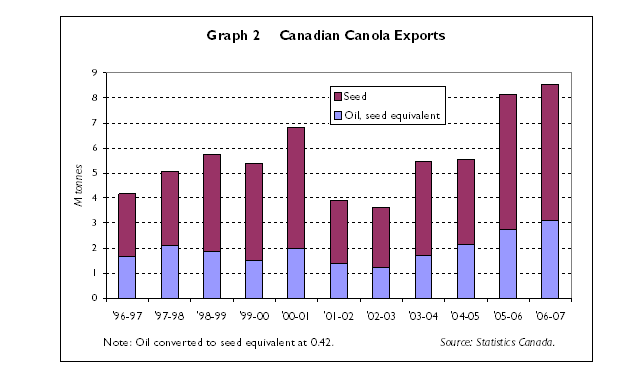 continued
Soyabean area and production in eastern Canada declined 18% to 2.9Mt in line with the US trend. Flaxseed production at 0.64Mt is down a third, mainly as a result of reduced area.
Transportation - An emerging challenge during the fall months will be rail capacity. While in aggregate 12-month terms Canada’s transportation system appears adequate to meet grain and oilseed supply needs, there is a push to take advantage of export opportunities that will diminish if and when Australia harvests a more normal crop. This is particularly the case for barley - malting and feed, and canola.
David Walker 001 780 434 7615
top of page