
US Food and Feed Markets
- Tuesday October 29, 2007
This analysis featured in the eptember 18, 2007 issue of the HGCA's MI Prospects, Volume 10, Issue 10
A combination of the unusually tight global supply situation for wheat and a very large US maize crop have resulted in unprecedented price premium for US wheat over maize. More normal prices relationships are not expected to be re-established until next year.
For many years the relationship between international food and feed grain markets have had little relevance to the UK grain market as provisions of the Common Agricultural Policy, particularly intervention support, combined with oversupplied markets insulated it from outside market influences. With wheat being both the major feed and food grain, such matters as milling wheat premiums have been largely driven by UK harvest weather, the consequential suitability of UK wheat for milling and the necessity to import from other markets within the EU. Similar to last season, this year’s EU grain prices are significantly above intervention support and as a result prices are more directly linked to market developments outside the EU.
US wheat - In contrast to the UK, the US use of wheat for livestock feed purposes is very limited. It is used predominantly for human food, both domestically and overseas, with the class of wheat usually determining where and how it is used. In recent years, annual US consumption of wheat as livestock feed has been limited to about 5Mt, and less than 10% of US wheat production (Table 1). Most of this occurs in the third, June to September, quarter of the year after the wheat harvest and before the maize harvest. Such factors as local availability, harvesting conditions and resulting quality may influence this use. However, wheat accounts directly for only about 5% of total US feed grain use.
continue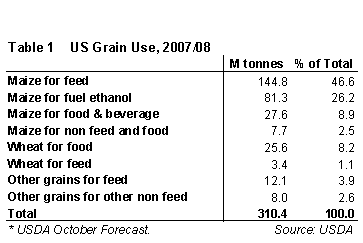 continued
Maize is the dominant US feed grain accounting for about 95% of feed grain consumption. While it is used in a number of foods, this use is insignificant relative to use as feed and the increasingly use in the production of fuel ethanol. Use of maize for food and beverage purposes amounts to about 27Mt compared to feed use of 150Mt.
Further, wheat and maize are generally grown in different geographic regions and few farmers have the option of planting one or the other, as most opt for maize and soyabeans. As a result of this, the US wheat and maize markets are driven by quite different supply and demand factors. Over the period from 2002 to 2006, however, wheat and maize prices have maintained relative stable price relationship with the wheat premium generally within a range of 30 to 70% (Graph 1).
continue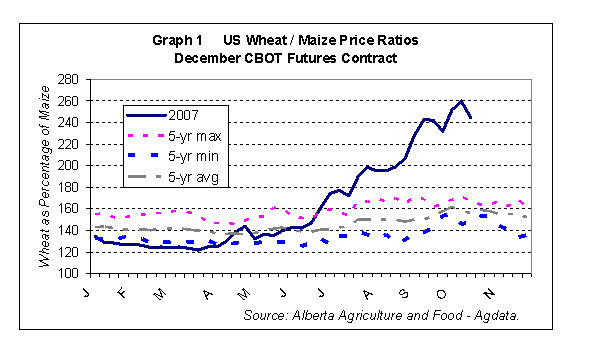 continued
This year, however, they have been much more volatile. Early in the year when there was doubt as to whether growth in US maize production would be able to match expanding demand for fuel ethanol production and winter conditions were proving to be favourable for wheat production, the premium for wheat was below this range.
In March, the USDA was predicting a critically tight stocks-use-ratio for maize of 5%, even after allowing for a 15% plus increase in production. For wheat this was projected to remain unchanged at about 18%. With these expectations the wheat premium slipped outside this range but on the low side (Table 2).
continue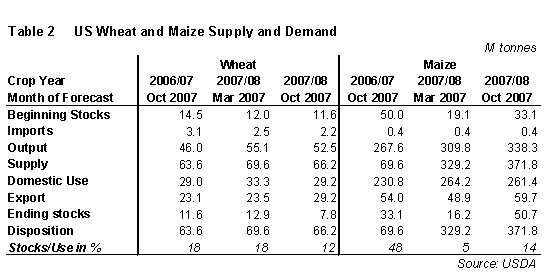 continued
As expectations for US maize production improved dramatically and world wheat output prospect deteriorated causing a blistering pace for US wheat export sales, both wheat prices and their premium to maize ballooned. In October, the USDA was projecting an end of season US stocks-to-use ratio of 12%, with a lower output estimate and increased export expectation than in March. For maize, the exceptional increase in harvest output more than offset improved export outlook with the stocks to-use ratio increasing to 14%.
In absolute terms, the premium for the December futures contract increased from US$16.50 / t, or 22% of the value of maize, in mid-March to US$222.80 / t, or over 250%, in late September. The cash premium widened to $194.80 / t for soft red winters over maize, fob US Gulf ports.
This acute situation must be causing pressures for adjustment in grain use in the US, if not elsewhere. While the substitution of maize for wheat in rations is the obvious focus, US feed wheat consumption is very limited and tends to occur almost entirely in the July / September quarter.
In this context with the prospect of tight maize supplies, the USDA forecast feed wheat use to increase to about 8Mt in March, whereas by October projected feed wheat use had been reduced by over 60% to about 3Mt. This is, of course, relatively insignificant and major adjustments will have to wait for the 2008 crop and the 2008/09 season.
2008/09 - A very early tentative, but nevertheless authoritative, indication of how this adjustment might occur was recently provided by Keith Collins, Chief Economist of the USDA, to the US House of Representative’s Committee on Agriculture. This unofficial forecast suggested US wheat planting would increase by 1.46M ha, of which about 1.0M ha would be from conservation reserve programs, to 25.9M ha. Implicit in the projected 67% increase in carry-over stocks during the 2008/09 crop year was a decline in US exports, the result of a recovery in world production. In support of this scenario, it was noted that new, 2008, crop futures had been trading at a $2.00 / bu, equivalent of about £36 / t, discount to current prices.
The scenario for maize is the converse of that for wheat. A 2.7M ha swing out of maize resulting in a 2008 planted of 35.2M ha, together with continued growth in use of maize for fuel ethanol production is expected to result in a tightening of supplies and higher prices. December 2008 maize futures are at a premium to current prices. And the ratio of wheat to maize futures prices for December 2008 is 1.72, which is at the top end of the usual range of price ratios for these two grains.
Thus, while there may be limited opportunities for adjustment during the current crop year, the necessary adjustments resulting in more normal relationship between food and feed grain prices are likely to be re-established next season.
David Walker 001 780 434 7615
top of page