
North American Review - 2007
- Monday December 10, 2007
This analysis featured in the December 10, 2007 issue of the HGCA's MI Prospects, Volume 10, Issue 13
This year has been anything but ordinary for North American grain and oilseed markets.
January is usually a quiet month for US grain and oilseed markets. This year, however, they had the challenge of absorbing the implication of President Bush’s State of the Union message on energy self sufficiency and the very significant implications for the demand for maize for ethanol production and the indirect effects of this on other grain and oilseed markets.
The first USDA post State of the Union supply and demand projections were made in early March.
For wheat the combination of a larger winter wheat area and much improved crop conditions prompted projections for an increase in output more than enough to offset reduced starting stocks. This allowed for both an increase in exports and a small build in ending stocks(Graph 1). Even though winter wheats in the southern US were damaged by widespread frosts in early April and the hard red winter wheat crop in the southern plains was harvested in uncharacteristically wet conditions, the crop is currently estimated at 56.3Mt, less than 5 percent below the March projection and 14 percent above 2006 output.
continue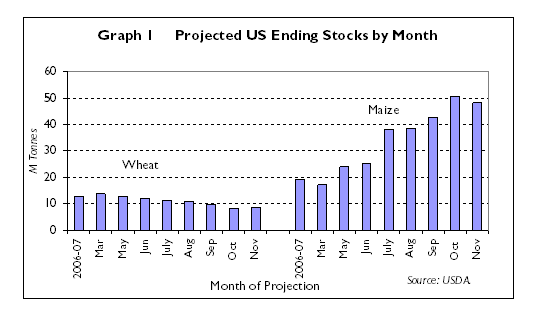
The failure of world wheat production to recover fully from the poor global crop in 2006 was not anticipated. As wheat stocks held by other wheat exporters had been exhausted the previous year, importers became very dependent on the US. US exports are currently projected at 31.3Mt, 24 percent above the USDA’s first forecast and 27 percent above last year.
The consequence of this increase in exports has been a reduction in ending US stocks projections from 13.8Mt to 8.5Mt and record prices in current dollar terms. Prices were relatively stable until June since when continuing reports of the faltering recovery in world wheat production resulted in prices almost doubling. That prices have backed off since early October probably indicates that there was some panic buying, something that is also apparent from US export sales data.
Prospects for 2008 are for a further, but probably modest, increase in planted area. The conventional wisdom suggests an increase of rather less than four percent, with much of this increase resulting from farmers choosing not to renew expiring Conservation Reserve Program contracts.
With the very ambitious bio fuel target set by President Bush it was not a matter of whether maize plantings would increase but by how much. In early March the USDA suggested 11 percent, in late March the planting intentions suggested 15 percent, but despite weather delayed planting an extra 19 percent was eventually put in the ground.
Yields were more than usually uncertain as fertilizer was reported to be in very short supply and there were questions as to the suitability of some of the extra area planted to maize. The crop, however, ended up yielding the second highest on record and production was 25 percent above 2006. At the same time as supply prospects were increasing, there was some shaving of ethanol use resulting from falling ethanol and increasing maize prices. While this was relatively insignificant in absolute terms, prior revisions to this statistic had always been upwards.
All this resulted in a substantial increase in projected year ending maize stocks, Graph 1. In turn maize prices have tended to languish. The well wether December maize futures established contract highs in March, when it became apparent that not only a substantial increase in planting was required to meet prospective demand, but near record yields to go with it. The delay in planting in late May threatened this and a second contract high was set.
Thereafter, crop development conditions appeared to be close to ideal and prospects for more than adequate supplies never threatened. Maize prices softened as those for almost all other grains and oilseeds advanced. And certainly this will have its impact on plantings next spring with expectations for which are generally in a 35.0 to 36.0M hectare range, down only about 5 percent.
Early in the season soybean prospects looked relatively poor with record world and US oilseed supplies. Also bio diesel prospects did not provide the boost to demand for soybeans that fuel ethanol did for maize. Prices did, however, appear supported by the prospect for an increase in maize planting cutting into potential soybean plantings and resulting supplies. This was, of course, more of a factor than initially anticipated, and as it became reality soybean prices rose accordingly. Last year 30.6M hct. were planted, in early March 28.5M were anticipated, and 25.8 M were actually planted.
Currently the market appears to be arbitrating between the need for US soybeans to be competitive in international markets and for prices to be sufficiently attractive relative to maize to encourage farmers to increase soybean plantings. The expectations are for somewhere around 28M hct. to be planted next spring with the usual range of developments including input costs, field conditions and market prices at planting time all influencing decisions.
Canadian prairie farm seeding decisions in 2007 seem to have been firmly based on experiences of the previous season. Areas seeded to canola and oats were well above recent ranges for these two crop following record exports the previous year at prices which were clearly acceptable. Wheat area was the smallest in more than 30 years although increases in durum and winter wheat offset to some degree the very sharp decline in other spring wheats.
Condition for early crop development were excellent, but a heat wave in July cut yield potential to average to slightly below average, depending on crop and location.
Canadian export availability is lower for most crops, generally more as a result of lower beginning stocks than reduced production, Graph 2. Exceptions to this are spring wheat, oats and barley. For spring wheat the 20 percent cut in supplies is mainly the result of the lowest seeded area in 30 years. Canada will again this year be the sole source of durum on international markets, at least on a net basis. While the US has a better crop, any US export sales that are made will require offsetting imports from Canada to meet domestic needs.
continue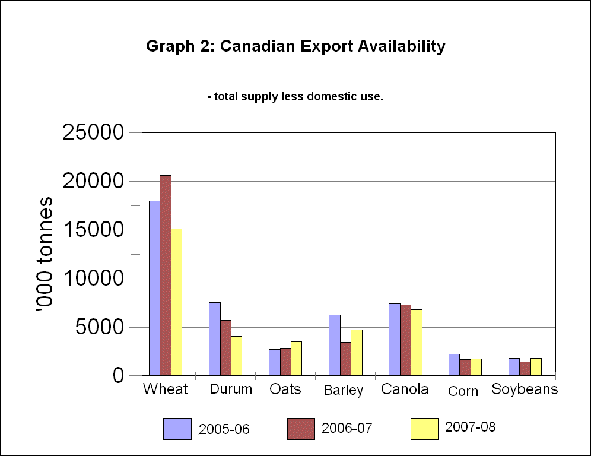
The oats crop far exceeds anything produced in Canada before and is of good quality. Canadian oat exports to the US have grown very rapidly in recent years with the resurgence of milling demand and Canada filling the void in US eastern seaboard equine markets formerly supplied with restitution assisted Scandinavian exports. There appears, however, to be 500,000 to 600,000 tonnes of oats surplus to foreseeable market requirements. But oats continue to sell at a significant premium to US corn, so the marketing does not appear to be under stress.
For barley an increase in seeded area and production area was sufficient to offset lower beginning stocks. Further substantial quantities - US export sales data suggest 600,000 tonnes already, of US maize is being imported into western Canada replacing barley in livestock rations thereby increasing barley supplies available for export. Much of this has the potential of meeting malt specification but with Australia and the European are without barley available for export, Canada is also temporary custodian of the Saudi feed barley market.
After a couple of, what appear to have been, exceptional years for canola exports - the result of EU bio diesel related demand for canola oil and the drought induced absence of Australia from international markets, this year’s production looked a little large. But with a less than complete recovery from the 2006 drought, Australia is not likely to be a major factor in Pacific markets and early season exports are encouraging.
In eastern Canada the swing out of soya beans and into maize which resulted in a record maize crop mirrored developments in the US corn belt immediately south of the Great Lakes.
David Walker 001 780 434 7615
top of page