
International Fertilizer Prices
- Tuesday February 19, 2008
This analysis featured in the February 19, 2008 issue of the HGCA's MI Prospects, Volume 10, Issue 17
International price increases for fertilizers suggest that a world wide phenomenon. Although it is believed that the recent rise in prices may not be sustained, supplies are not likely to be sufficient to pressure prices for some time.
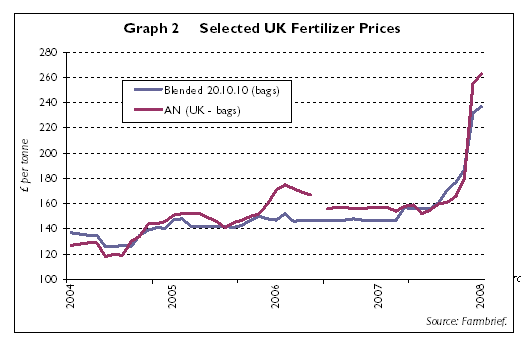
Energy costs started to increase steeply towards the end of 2005 and particularly natural gas rose sharply for a short while after Hurricane Katrina interrupted US oil and gas production in the Gulf of Mexico. Given that natural gas is a major cost component in the manufacture of ammonia and urea, and that the US was very dependent on domestic fertilizer manufacturing, US nitrogen fertilizer prices increased (Graph 1) accordingly. This was also reflected in stronger UK prices (Graph 2).
continue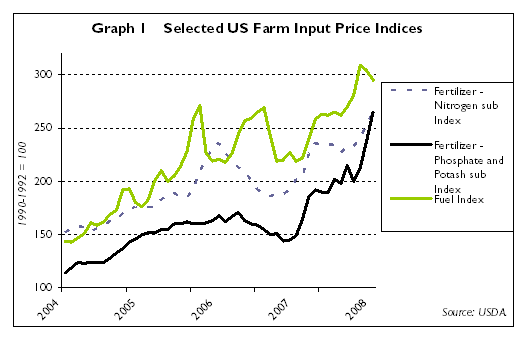
continue
However, this period of high prices was relatively brief. In some regions, eg in Western Canada, fertilizer prices remained relatively stable (Graph 3). Fertilizer manufacturers held long-term fixed price contracts for natural gas and were thus not dependent on spot markets. This suggests that the 2005 adjustment in prices was related to the brief increase in natural gas costs. Since then natural gas prices, while very volatile, have remained below peak levels seen in 2005. This is in contrast to crude oil prices.
continue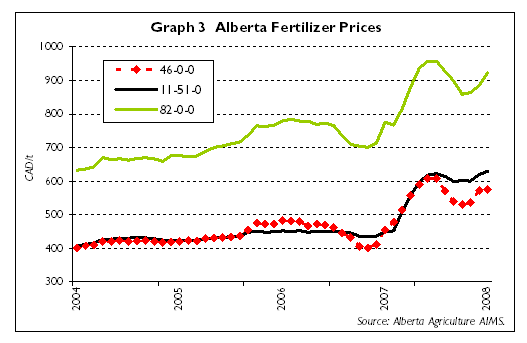
Increased demand for nitrogen fertilizers ‘N’, however, became a factor in the North American market about a year ago. This followed the prospect of a big increase in the planting of maize - a heavy user of ’ N’, at the expense of soyabeans - a light user of ‘N’. This was accompanied by concern as to whether supplies would be adequate to meet crop requirements and particularly whether supplies could be imported from the Persian Gulf in time to meet the deadline of the increased planting demand.
It is evident from near record US maize yield last year that US supplies of fertilizer were adequate last spring. After the peak application period for ‘N’ fertilizer past, prices levelled off. Over this period natural gas prices were relatively stable, again suggesting prices were driven, in contrast to 2005, by demand (Graph 4).
continue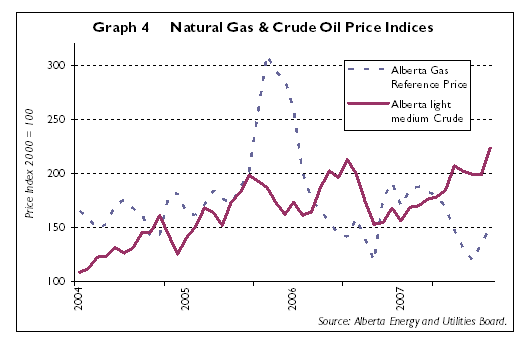
Meanwhile, the cost of the potash and phosphate components had started to increase. By the autumn when preparations for sowing winter wheat were being made, however, it was apparent that prospects for harvest 2008 prices were at an incentive level. Fertilizer prices took off as farmers sought fertilizer requirements for their winter wheat crops. Those farmers were not only in Europe and North America, but also in China and India - the two largest wheat producers.
The abruptness of recent fertilizer price movements may not be indicative of expectations for either short or long-term price prospects, but rather seasonal demand driven in a tight supply situation.
Looking further forward, there is a general expectation that biofuel stimulated production will result in a continued increase in demand for all types of fertilizer. And that the capacity of the fertilizer industry to meet demand will influence prices in a way that has not been the case for many years.
Factors influencing supply prospects for nitrogen fertilizer are quite different to those for phosphate and potash. The very limited recycling possibility through organic production aside, nitrogen fertilizer is produced from energy. Phosphate and potash are mined.
Natural gas is the most widely used source of energy for nitrogen fertilizer feed stock manufacture, almost certainly because it is the most cost effective. Natural gas values vary according to location, particularly with access to pipelines that allow it to be pumped to the market. In recent years ammonia and urea production has increasingly migrated to location such as the Arabian Gulf where natural gas, often a co-product of crude oil would otherwise be flared off.
While capital investment in such production facilities is substantial and takes time to put in place, it is expected that demand for the nitrogen component of fertilizer can be more readily met than that for phosphates and potash. Industry expectations are that increased production capacity will be sufficient to match expanding demand by 2009. There is also some expectation that growth in demand for nitrogenous fertilizer will be slower than that for phosphate and potash in this time frame. A somewhat smaller area of maize in the US will contribute to this trend in 2008 but probably not in 2009.
The major traditional sources of phosphates for fertilizer production are West Africa and Florida. China has emerged as an increasingly important source but there is some uncertainty about the future of this source. Much of the increase in global phosphate production this year is anticipated to be in China.
The major sources of potash have been Saskatchewan and Russia. Improved prospects in recent years have resulted in increases in output at existing mine. But Fertecon suggests substantial investment in new capacity will be required which will increase cost of production thereby raising cost structures. Such projects typically take about seven years to complete. Hence, it may be some years before potash supplies will again be surplus to immediate needs.
At the same time the recent and very abrupt increase in fertilizer prices is not expected to be sustained, but it does not seem likely that the supply of fertilizer will be sufficient to pressure prices for some years.
David Walker 001 780 434 7615
top of page