
Futures Market Prices
- Monday March 31 2008
This analysis featured in the March 31, 2008 issue of the HGCA's MI Prospects, Volume 10, Issue 20
The major North American futures markets, and the Chicago market in particular, have long been regarded as a barometer of international values for grains and oilseeds, amongst other things. Daily reports on these markets have provided an authoritative log of major developments that had, or at the time were considered likely to have, an impact on prices. The classic weather market during the growing season is the epitome of this.
In recent months outside money appears to have taken over the markets. And with little news to direct markets in what in winter is normally the quiet season, there has been totally unprecedented price volatility(Graph 1).
continue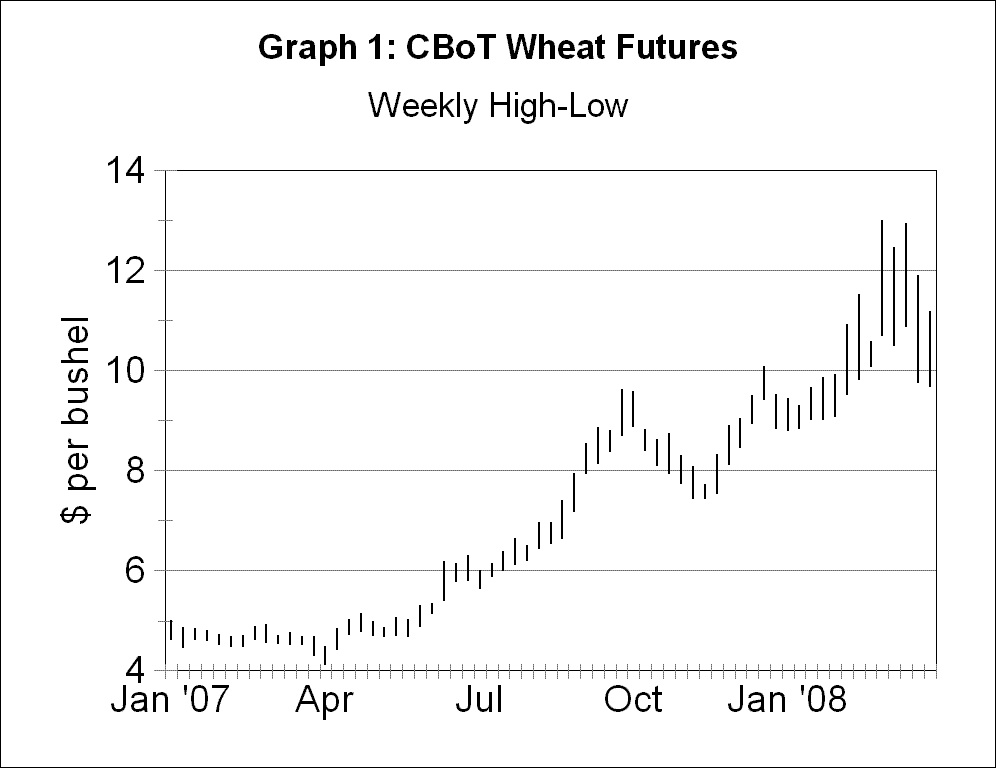
In the case of old crop wheat some justification for extremely volatile prices can be made. This years global supply situation is extremely tight. Even very small changes in levels of consumption, revisions in harvest estimates for late southern hemisphere crops and even the potential for delay in the earliest northern hemisphere crops could have a material impact on demand relative to very limited supplies.
But for most observers price movements for old crop wheat are of little more than academic interest. The bulk of the crop has long been sold and uncommitted grain on farm is almost certainly rare. What is of greater concern is the volatility in new crop prices. And the apparent inability of the market to discriminate meaningfully between old and new crop wheat and, indeed, between different grains and oilseeds, is becoming something of a frustration.
That grain and oilseeds markets are limited up and then limit down, not only on successive days but on occasion on a single day, seemingly because financial and other outside markets are moving in these directions, makes little sense.
A rise in prices occasioned by an event of limited relevance to the production or consumption of grain might seem a fortuitous opportunity to sell. The reality for a farmer contemplating forward contracting is a concern that there is some yet to be disclosed cause for the rise. And many may regard this as the major lesson to be learned from 2007. Further probably because of the extreme volatility and the inherent risk to brokers and merchants in offering forward pricing there is a very wide gap between futures prices and what is being bid ex farm.
The question then arises as to when will we see prices that are a meaningful indication of current expectations for 2008 and offers more in line with the futures market. Anticipating a price level is surely too much to expect in such a market as this. But there is still plenty of latitude to commit to a price that will cover costs.
What can be said with a degree of certainty is that while prices for all grains and oilseeds, new and old crop, are being buffeted up and down by outside influences the market is not reflecting values in a meaningful way, nor will they be reflected in farm gate bids. The converse of this is that when this ceases to be the case the market is settling down to its usual role of arbitrating values between buyers and sellers.
Perhaps real grain and oilseed traders have done the smart thing and taken a holiday. And this may be part of the problem. They will no doubt be back as soon as they see sense in the market.
David Walker 001 780 434 7615
top of page