
Canadian Barley Situation
- Monday November 10, 2008
This analysis featured in the November 10, 2008 issue of the HGCA's MI Prospects, Volume 11, Issue 10
Key Points
With relatively low supplies but favourable quality and an advanced sales position, Canada is likely to be successful in sustain malting barley sales in a much more competitive international market this year.
Supply Situation - Statistics Canada’s September production estimate of principal field crops placed the Canadian barley harvest at 11.2Mt, 2% above 2007 output. A decline in harvested area of 14% to 3.4Mha was offset by a 22% increase in yield to 3.3t/ha.
Supplies of Canadian barley are, however, on the low side for the second successive year. At 12.9Mt, they are up about 3% from last year (Table 1). This small increase in supplies does not, however, provide much indication of export availability or probable exports which remain uncertain.
continue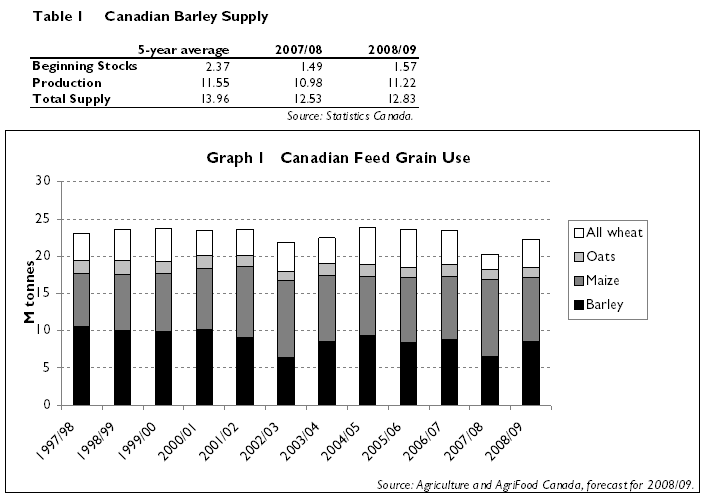
2007/08 Disposition - Canada exported 3.9Mt of barley last season, the highest in 20 years, despite relatively low domestic supplies. Much of the increase in sales was feed barley to Saudi Arabia(Graph 2). The business was done early in the season as soon as it became apparent that the barley harvests across Europe and Australia were poor. Significantly, much of the exports were done during the very brief period between the Canadian government’s deregulation of the Canadian Wheat Board’s single desk (CWB) for barley and a court ruling that the deregulation was illegal. The CWB, however, honoured the contracts made by the trade and continued to sell barley to Saudi Arabia.
continue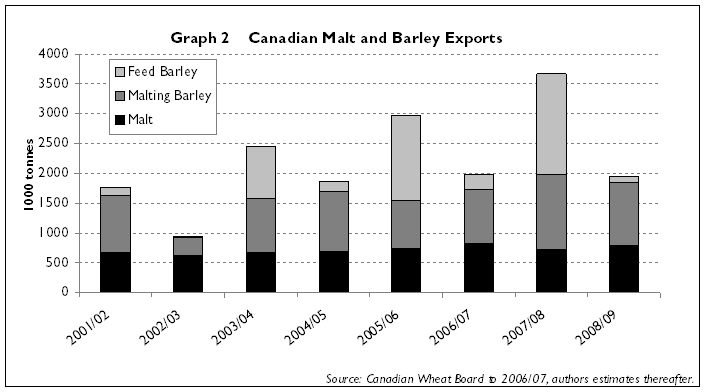
In a statistical context, 2007 Canadian barley supplies after allowance for domestic feed requirements were not adequate to meet significant feed barley exports. In addition, the wheat crop was also relatively small, of high quality and sought after on international markets and, hence, a very expensive feed source for livestock feeders. For political reasons - favouring grain growers at the direct expense of livestock feeders -, the CWB would almost certainly have delayed, if not forgone much of the Saudi business. Fortunately the US had harvested a record maize crop. US maize prices were relatively competitive and the dollar exchange favourable. As a result US maize was imported to replace barley which had been sold into export markets. This was a similar scenario to that of 2002/03 when western barley supplies had been reduced by drought (Graph 1, see above).
2008/09 Prospects - The current situation is very different. Barley harvests across Europe have very much improved, at least as far as quantity is concerned, and the Ukraine has already started to fill the Saudi market. In addition, more barley is also expected to be available from Australia.
Further, the CWB’s single desk is back in a position to arbitrate the western Canadian feed grain supply situation. The opportunity of supplementing short barley supplies with relatively inexpensive US maize has been eliminated by a much tighter US supply situation and much higher prices. The quality of the Canadian wheat crop is more typical than last year. Thus, more feed wheat will be available. On balance, however, supplies of Canadian barley for export for feed purposes appear limited if levels of malt and malt barley exports of recent years are maintained. Conversely Canadian supplies of malting barley, quality issues aside, will not be abundant this year.
No year is ever perfect with regard malting quality. This year early maturing barley, perhaps 30% of the crop, was harvested in good condition before a wet spell in September. Untypically fine weather during the second half of September allowed most late maturing crops also to be harvested in good conditions. As a result selection pressures for malting barley are not expected to be exceptional this year and all Canadian barley exports could potentially meet malting specifications this year.
The challenge this year is increased competition on international markets. European barley production has recovered, although there may be quality challenges with later harvested barley in some regions. Threatening the market is the potential for a much larger Australian crop and exports. In September (three months before harvest), the Australian Bureau of Resource Economics forecast an Australian barley crop of 7.8Mt and exports of 5.1Mt (16% above ‘07/08 and 63% above the drought year ‘06/07). This would raise competition for Canadian barley in Pacific markets. Further, and specific to Canada, a recovery in US barley production and quality will result in reduced exports to the US after a rather exceptional year last year. As a result, some accumulation of carryover stocks in Canada is anticipated.
Pool Return Outlook - The Canadian Wheat Board in late October, and as the global financial crisis was deepening, held its 2008/09 pool return outlook (PRO) two-row malting at C$327.00/t. This is above PRO’s for top grade red spring wheat. The CWB cited ‘the collapse of ocean freight rates, the weaker Canadian dollar and particularly the relatively advanced sales position of the malting barley pool’ as reasons for holding its projections in the face of slumping cash markets. Its final PRO for the 2007/08 pool was C$288.00/t. The values are basis in store Vancouver or St Lawrence ports. Deductions for freight, country elevation and removal of dockage are about C$60.00/t depending on location. For the 2008/09 feed barley ‘A’ (early season) pool PRO was lowered from C$198.00 to C$193.00. After allowance for marketing deductions, this is well below cash and futures prices. This suggests that feed barley deliveries to the CWB will be very limited. The unprecedented premium for malting barley, about 100% at the country elevators, will however ensure supplies for the board.
Post Script - A caveat to all of the above is naturally necessary in the context of the exceptional conditions prevailing in financial markets in recent weeks and the impact they may have on economic conditions and demand over the next 12 months. The assumption made is that while confidence in debt markets is being restored, recessionary conditions can not be avoided. This is unlikely to have a significant impact on product demand in western and developed economies. But it could have in less developed economies including China which is now a significant market for malting barley. The assumption is made that it will not.
David Walker (001) 780 434 7615
top of page