
Canadian Wheat Update
- Tuesday December 9, 2008
This analysis featured in the December 9, 2008 issue of the HGCA's MI Prospects, Volume 11, Issue 12
Key Points
A relative large and good quality Canadian wheat crop is expected to result in well above average Canadian exports.
Canadian Wheat Supply
Canadian farmers harvested 10.1M hectares of wheat this year, 17 percent above the 2007 area. Harvest area for hard red spring wheat was up 8 percent, while that for winter wheat, durum and other spring wheats were up 68, 25 and 19 percent, respectively. At less than 57 percent of total harvested area, hard red wheat this year was the smallest proportion of total wheat recorded since Statistics Canada started surveying wheat by class in 1991. It extends a downward long term trend(Graph 1).
continue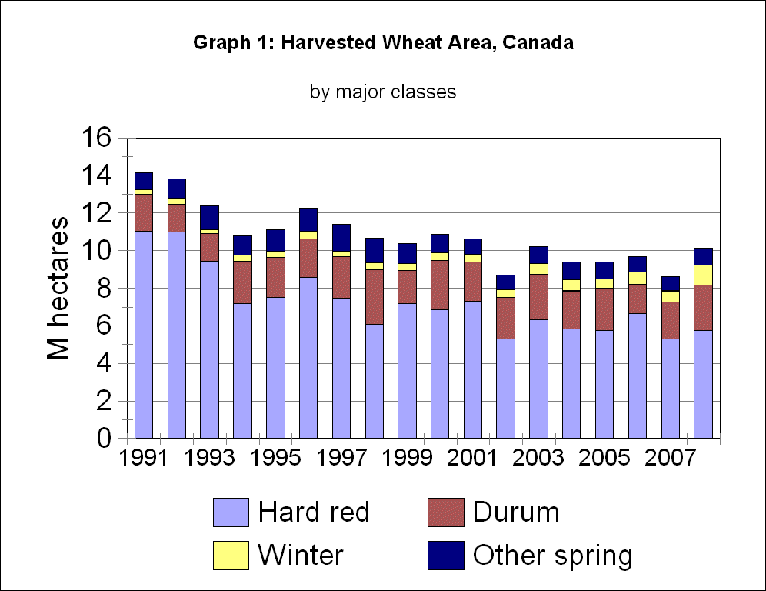
Prairie farmers reduced summer fallow by about 1.9M hectares, effectively allocating about 1.0M hectares to wheat. Of particular significance was a 0.25M hectare, 105 percent, increase in Ontario winter wheat area resulting from a combination of good seeding conditions and favourable price relationships. A parallel shift from feed grains to wheat occurred on the Prairies.
Yields were generally above average for all classes of wheat, except durum and soft white springs. An aggregated yield of 2.9 tonnes per hectare was, however, the highest ever recorded as the area of higher yielding winter and, mostly irrigated, soft white springs were a larger proportion of the total than usual.
Total production of wheat - excluding durum, are estimated by Statistics Canada to be 23.1M tonnes, 41 percent above the area and yield reduced 2007 crop and 16 percent above the five-year average. Durum production is estimated to be 5.1M tonnes, 50 percent above 2007 production which was also reduced by relatively low area and yield and 24 percent above the five-year average(Table 1).
continue
Table 1: Supply Disposition of Wheat and Durum

             Wheat, excluding Durum                   Durum
            5yr avg                   2008-09 as %   5yr avg                   2008-09 as %
             '03-08  '07-08  '08-09 5yr avg '07-08   '03-08  '07-08  '08-09 5yr avg '07-08
'000 tonnes
Carry in      5,169   5,595   3,975    77     71      2,085   1,232     842    40     68
Production   19,864  16,373  23,092   116    141      4,437   3,681   5,51    124    150
Imports          20      21      20   102     95          2       3       1    50     33
Total Supply 25,053  21,989  27,087   108    123      6,524   4,916   6,362    98    129

Exports      12,618  12,679  15,300   121    121      3,714   3,175   3,500    94    110
Domestic food 2,930   2,882   3,400   116    118        249     235     260   104    111
Domestic feed 4,362   2,453   3,000    69    122        631     664     650   103     98
Carry out     5,143   3,975   5,387   105    136      1,930     842   1,952   101    232
Total disposition
             25,053  21,989  27,087   108    123      6,524   4,916   6,362    98    129
Domestic food includes industrial use, domestic feed includes seed, dockage and residual

Source: Statistics Canada and Food and AgriFood Canada, forecasts the authors.
While not uninterrupted by rain or totally free from frost, harvesting conditions were generally favourable. In particular weather for the later stages of what began as a late harvest were close to ideal. Informal provincial government surveys suggest, in aggregate, better than average quality. Saskatchewan put estimated 86 percent of the crop made the top two grades compared with a 69 percent ten-year average. Canadian Grain Commission Harvest Sample Program analysis indicate test weights slightly below average, protein close to average and Falling Numbers above average for milling quality wheat.
Fusarium head blight has caused some downgrading of wheat harvested after rain delays in Manitoba and eastern Saskatchewan, but this is not an unusual occurrence in recent years. Conditions for the propagation of ergot were relatively favourable during cereal flowering so it is more widespread that usual. In neither instance has the supply of export quality grain been materially effected.
Carry-over stocks of wheat excluding durum of just under 4.0M tonnes were the lowest in living memory with both very favourable prices and the recent centralization of the inland elevator system enabling stocks to be reduced even below those following the drought reduced 2002 crop. Total supplies for the crop year of 27.1M tonnes are, however, 23 percent above year ago levels but only 8 percent above the five-year average.
Carry-over stocks of durum at 0.8M tonnes were also exceptionally low and the lowest since 1998. Total supplies of 6.3M tonnes are 29 percent above 2007, but 2 percent below the five- year average.
Canadian Wheat Disposition
Annual domestic food and industrial wheat use has traditionally ranged between 2.7M and 2.9M tonnes with an upward trend with population growth. In recent years the opportunity has existed for growth in consumption of up to 1.0M tonnes as a result of the development of Western Canadian ethanol production facilities. Often it has been economic for plants to import US maize and as a result this potential has not been met. But with an increase in production of high starch soft white wheat and generally improved supply conditions this year it would be reasonable to expect some recovery in ethanol production from wheat this year. With relatively favourable harvest conditions feed quality wheat is likely to be in short supply and wheat feeding limited.
With a weaker Canadian dollar and a quality crop to market the Canadian Wheat Board(CWB) is in a better position than most of the competition. And it would be reasonable to expect it to take advantage of this, but ending stocks will almost certainly rise above average levels of the last five years.
Domestic use of durum is relative stable, only increasing when the quality of the crop makes it difficult to move it into traditional cous cous and pasta markets. With the US expected to again be a net importer of durum, the CWB has, being the sole major source, some control of its destiny in the global marketplace. Domestic production in north Africa, the main international market for durum, having recovered from last year, the CWB is likely to be a restrained seller. It has some latitude in terms of the very low level of carry-in and the opportunity to adjust marketing strategies toward the end of the crop year as crop conditions in the major importing countries unfold. Ending stocks will build to five-year average levels.
USDA forecasts of a month ago for a 15 percent increased in total Canadian wheat exports to 18.5M tonnes now seem a little modest.
Further in raising its Pool Return Outlook for durum by C$10.00 and other wheat by C$5.00 in November, the CWB signalled some confidence in its wheat export program. It cited challenges with southern hemisphere wheat crops, lower ocean freight rates and the lower Canadian dollar while acknowledging pressure on markets from abundant but generally lower quality supplies from across Europe. It lowered, however, the PRO’s for barley.
2009-2010
Looking ahead to the 2009, it is evident that the winter wheat area will be down. Both on the Prairies and in Ontario spring seeded crops were late being harvested. This almost certainly impeded fall seeding. Further price relationships between wheat and alternate spring seeded crops were not as favourable as last year.
An additional concern is poor fall soil moisture. Just as weather favoured harvest, there was little in the way of late season precipitation to recharge soil moisture over much of the Prairies(see Map). This means that the 2009 crop will be more than usually dependent on timely rains next spring and summer.
continue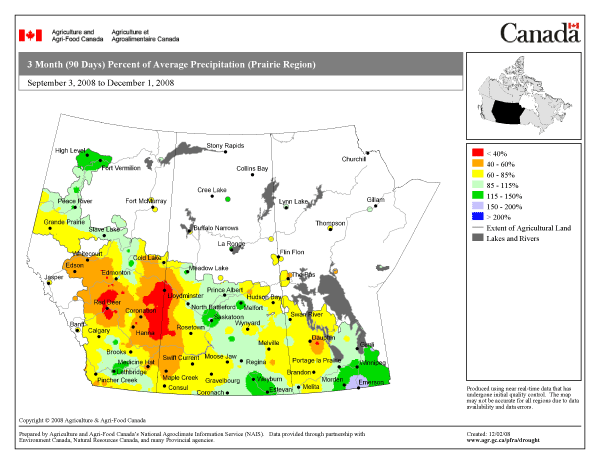
This year’s low level of summer fallowing is unlikely to be sustained next year. The risk of drought conditions in the spring are likely to be seen as being higher and rewards in terms of commodity prices lower. As in the drier areas of the Prairies, the major options tend to be wheat or summer fallow, wheat area is likely to be reduced.
David Walker (001) 780 434 7615
top of page