
USDA Baseline Projection 2009
- Tuesday March 3, 2009
This analysis featured in the March 3, 2009 issue of the HGCA's MI Prospects, Volume 11, Issue 17
Key Points
Prior to this year the USDA baseline projections indicated that the fuel ethanol phenomena would reduce the area sown to other crops and inhibit growth in US grain and oilseed exports. The 2009 projections, allowing for higher crop yields, and the release of land from the Conservation Reserve Program and cotton production, envisages long-term growth in US grain and oilseed production, exports.
Background
Every year the USDA publishes a set of long-term supply and demand, agricultural trade, farm income and food prices tables together with a summary text. These provide a scenario for major US commodity market developments for a ten-year period. This year the period to 2018-19 was covered. They are particularly valued in the context of strategic and investment planning.
The USDA naturally stresses their limited value for nearer term market forecasting and emphasizes that they are made with the baseline assumptions that there will be no changes in domestic and international government policy. Further they are undertaken toward the end of year before crop development has been materially impacted by weather - long-term trend yields are used. Since the projections are initially used for internal government budget planning, they are probably subject to rather more scrutiny than conventional USDA reports.
Revisions in successive annual projections are almost certainly as instructive as the projections themselves. They provide an indication of how developments of the past year have influenced future prospects. Last year's agenda, of course, included record prices for grains and oilseeds but only the onset of recessionary conditions just as the projections were being made.
The Case of Maize
Maize, unquestionably, has been more significantly impacted by non-random influences than any other farm commodity. US policy developments supporting the production of fuel ethanol and last year's announcement of alternate energy targets have been and are expected to continue to be felt beyond the feed grain market and the US. The goal was to reduce American gasoline consumption by 20% over 10 years, mostly through a nearly five-fold increase in the use of home-grown fuels like ethanol by 2017.
Successive USDA baseline projections had raised the future planted area scenario for maize prior to 2007 as ethanol programmes were enhanced. But it was the State of the Union targets that raised expectations, as it confirmed that government incentives for fuel ethanol production would be maintained. Hence, in 2007 the projected planted maize area for the forecast 2010-2014 period was increased by 2.1Mha. And with the 20% increase in area actually planted in 2007, the average projection for the five-year period was raised a further 0.7M ha in 2008.
This year's future scenario is particularly complex having to reflect record prices earlier in the year and the very different conditions in October and November 2008 when the projections were being made - crude oil prices and much else in free fall. Projections for growth in the use of maize for ethanol were not changed significantly. The use of maize for ethanol production is, of course, directly related to gasoline consumption, as demand for it is a result of mandated blending.
A caution is perhaps necessary in the context of using this future scenario as a forecast, since the macro economic assumptions made at the time of the projection may now appear a little optimistic. One such headline assumption was crude oil prices at $60 per barrel while they languish at about $40.
Implications for other US Crops
If the area planted to maize is to increase, then the area used for other crops has to decline. The initial expectation was that the increase would occur at the expense of future soyabean area. These two crops are grown in almost identical geographic areas, by the same farmers, using the same equipment.
As the future scenario for maize area was raised, the area for soyabeans was reduced (Table 1). Soyabean plantings did dip by 4.4Mha for harvest 2008, accommodating much of the 6.1Mha increase in maize area. But the following year the soyabean area recovered completely with this only partially at the expense of maize. As a result, the role that soyabeans was expected to play in an increase in maize area has been scaled down considerably.
The third largest crop in the US after maize and soyabeans is wheat. But much of US wheat is grown in areas not suited to maize production. Soft red winter wheat (SRW) is grown east of the Mississippi where maize and soyabeans are prevalent, but typically this class of wheat makes up less than 20% of total US wheat area. Probably planting of soft red winter wheat was expected to lose out to spring crops with the exception of last season. A couple of short global wheat crops resulted in very favourable returns for wheat production and saw an increase in the SRW area. For harvest 2009, the SRW area is expected to return to 'normal'.
The crop that is now expected to decline to the greatest degree is cotton, which appears to have been unexpected. Cotton plantings fell precipitously in both 2007 and 2008. Only following this were 2010 - 2014 projections for cotton planting adjusted. These were cut from 5.6M ha in the 2007 projection to 4.0M ha in this year's projection (Table 1). Actual area planted in the year preceding these projections were 6.1 and 3.4M ha.
continue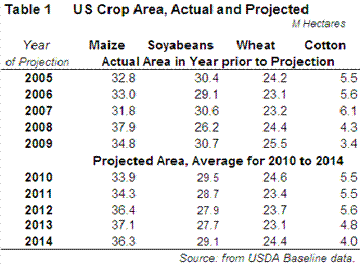
Cotton is grown in areas where both maize and soyabeans are grown. In the past, however, these two crops were not seen as a serious risk to cotton. It occupied, perhaps, a similar niche to sugar beet in the UK as a relatively high value crop that required more managerial and cost inputs. But changes in relative crop values appear to have been sufficient to encourage this adjustment. However, the very recent record prices together with some Conservation Reserve Program adjustments are projected to result in an increase in overall cropped area in the US. This will do much to accommodate increased maize plantings. Between 2005 and 2009, the USDA lowered its projection of potentially arable land in this programme by 2.3Mha.
Export Implications
Of greatest interest outside the US is the impact on future US exports of these developments. The initial expectation was for diminished prospects for US grain and oilseed exports with an increase in fuel ethanol production from maize. Exports for maize and soyabeans were expected to decline relative to those of the last five years and those for wheat to increase by a decreasing percentage. The future scenario for cotton was an increase.
This was reversed this year for three of the major crops, with maize being the exception. Longer term factors at play in this reversal appear to be the expectation of improved yields with higher commodity prices, the release of Conservation Reserve Program land for cropping and the seeming permanent decline in the viability of cotton as a cropping option. But even with the growth in export, the baseline projections suggest US grain and oilseed exports will decline as a percentage of total world trade.
Apparent from the 2009 baseline scenarios is the expectation that the impact of US ethanol policy may be spread wider, but will be less evident in maize markets in general and US maize exports in particular than in earlier projections.
David Walker (001) 780 434 7615
top of page