
Emerging US Crop Prospects
- Tuesday April 28, 2009
This analysis featured in the April 28, 2009 issue of the HGCA's MI Prospects, Volume 11, Issue 21
Key Points
US crop conditions are mixed for winter wheats. Concerns over the condition of the hard red wheat crop in the southern Great Plains are generally offset by the favourable conditions for soft red winter wheats east of the Mississippi. Soil conditions are currently too wet for rapid field work, but eventual prospects remain favourable for spring wheat and maize although planting is a little late this spring. Soyabean sowing is now only starting in the far south.
Improved world supplies of most grains may have dimmed the red alert over crops prospects apparent at this time last year, but in a longer term perspective, the cushion of ending stocks is not yet overly comfortable. There is still the possibility of variability in global output this season. And with the economic environment for growers having deteriorated so drastically, the cushion may not be as firm as its statistical appearance suggests.
US Winter Wheat - Although the US is still the largest exporter of wheat, it is a lot less dominant in the wheat trade than it used to be. This year US exports are expected to be not much more than 20% of world trade and production about 10% of total world output. With the cushion rather arbitrarily assessed at 15Mt (current expected ending stocks less the average of last year's beginning and ending stocks), a poor US crop is unlikely to make a difference on its own. The implicit cut in US yields necessary to eliminate that global cushion would require something like a one-in-ten year occurrence. Early US crop prospects are not ideal but do not point to this.
The crop in aggregate went into dormancy in better-than-average condition, except for Texas and Oklahoma, but came out worse than normal (Graph 1). As of April 19, 43% of reports rated the US winter wheat crop in good or excellent condition compared to 45% last year at this time and a five-year average of 51%.
continue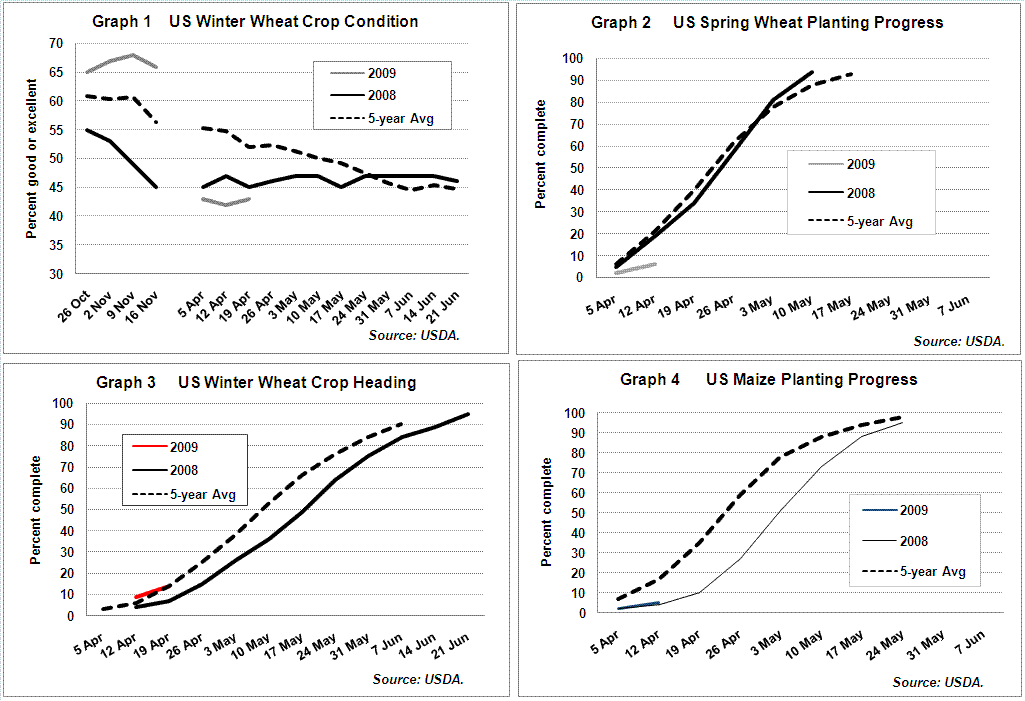
There has not been any slippage of favourable ratings this month but poor and very poor ratings have increased from 22 to 27%. This is largely the result of very poor conditions in a relatively small area of Texas and less markedly in Oklahoma. Together these US states account for about 20% of total US wheat area. Texas and Oklahoma are major hard red winter wheat states which are ordinarily subject to declining conditions as crops mature.
Crops in both these states but particularly in Texas are heading well ahead of normal, suggesting a narrowing window of opportunity for recovery (Graph 3).
Reported conditions of the white winter wheat crop in the Pacific North West appear about average. But those of the soft red winter wheat crop in the Corn Belt look good, even if the planted area is reduced. In the south east crops have been developing amid very wet conditions. This has raised concern over the potential for disease damage to the crop, although as yet nothing of significance has been reported.
The crops of 2006 and 2001 showed similar condition at this stage to current US crop conditions. On that experience a crop of about 2.8t / ha would be a reasonable expectation. After allowing for area abandonment, a crop of 37.5Mt (based on current conditions) appears a reasonable assumption. This which would be at the low end of the normal range for US winter wheat production.The USDA's first survey-based estimate of the winter wheat crop is published on 12 May.
Spring Wheat - Planting of the spring wheat crop in the northern Great Plains is in its early stages and somewhat later than average. Planting as of April 19 was reported 6% complete compared to 19% at this time last year and a 21% average (Graph 2). Prospects are almost certainly above average at this time as field conditions are reported as abnormally wet with more than usual flooding having occurred. But this bodes well for crop developed provided planting is not delayed unduly. In a very general context it would not be unreasonable to expect improved yields to offset reduced 2009 area, resulting in a crop of durum and other spring wheat of 16Mt.
In aggregate the rather poor condition of the southern hard red winter wheat crop is largely offset by better conditions for soft red winter and hard red spring wheats.
Maize - Planting of maize has been delayed by wet and probably cool soil conditions. As of April 19 the USDA reported 5% of the crop planted compared to 4% last year and a 14% five-year average (Graph 4). Planting in the major mid-western maize producing states only normally starts in mid-April, so the most recent crop report is the first one in which significant progress could be expected. It might seem that planting is about a week behind average.
But recent experience suggests that early season delays of this nature should not be considered prejudicial to eventual harvest outcomes. US farmers' planting capacity appears to have increased significantly in recent years. In 2007 over half the maize crop was planted during the first two weeks of May, before which planting was well behind normal. Only after mid-May are farmers likely to consider the option of switching area to shorter season soyabeans.
The US maize supply situation is still relatively tight. Prospective plantings were below what most observers envisioned. Assuming trend average yield, surplus to domestic needs and available for export is likely to be below either this or last year's levels. And, as the US's contribution to world coarse grain trade is 75%, which is largely maize, US maize crop development will continue to be watched with more than usual interest.
Soyabeans - Farmers generally sow soyabeans after they have finished with maize where the two crops are grown in the same area, which is the norm. And even in some instances after wheat has been harvested. The USDA starts reporting planting progress for soyabeans this year on April 26 which is indicative of when planting starts in southern states.
David Walker (001) 780 434 7615
top of page