
North American Crop Update, July 2009
- Monday July 20, 2009
This analysis featured in the July 20, 2009 issue of the HGCA's MI Prospects, Volume 12, Issue 2
US crop prospects are now relatively favourable despite delays in spring sowing. On the Canadian Prairies prospects are for below average crops.
US Crops
Winter Wheats - With the combines pretty well finished in Kansas, winter wheat prospects are now close to assured. The crop was reported by the USDA to be 66% harvested on July 12. In its last winter wheat condition report on June 27, the condition of the crop was rated 45% good or excellent, just above a five-year average. Since winter, when crop conditions slipped from well above average pre-dormancy ratings, the crop has in aggregate gained on average ratings through to maturity. Drought persisted in parts of Oklahoma and Texas but this was offset by above average prospects elsewhere.
The USDA's July 1 estimate of production placed the winter wheat crop at 33.8Mt, 19% less than the 2008 crop with area down 12% and yields off 7%. Harvested area, yield and production were all close to the five-year average, but abandonment was higher than average.
In terms of supplies of winter wheat, the reduced output will more than offset the higher beginning stocks brought forward from last year. The adjustment has been greatest for soft red winter. Supplies of both hard red winters and soft red winters are above the five-year average, but this is a result of the higher level of opening stocks (Graph 1).
continue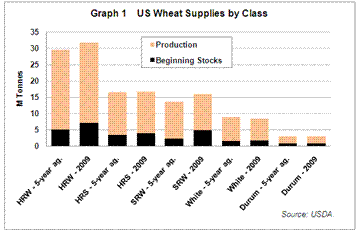
Spring wheats were sown late due to wet field conditions and cool weather in the Northern Great Plains. To-date, this has not been a handicap to the crop which has maintained above average condition. But the crop may be more than usually susceptible to hot and dry conditions between now and harvest which usually starts in early August. The risk of frost if conditions continue abnormally cool is probably less threatening.
In its first estimate of spring wheat output, surveyed in late June / early July, the USDA placed durum and other spring wheat production at 2.2M and 13.7Mt, respectively. Durum production is down 4% from last year but above the previous five-year average. Area is slightly above average and yield is expected to be slightly below average. The other spring wheat production estimate is down 7% from last year. Area and expected yield are lower than 2008, with area slighter higher than the five-year average and expected yield just about average.
US supplies of durum, in an historic context, are again low this year and the USDA projections suggest that the US will be a net-importer as it has been in two of the last three seasons. Spring wheats will be in better supply than last year as an accumulation of beginning stocks more than offsets reduced output. But supplies are expected to remain slightly above the previous five-year average.
Maize - While wet field conditions and cool temperatures delayed planting of the maize crop particularly in the eastern half of the corn belt, conditions for the growth of the crop thereafter and up to the critical reproductive phase of development have been favourable.
Crop ratings have consistently improved over the last six weeks. And the crop appears overall to be less than a week behind average as silking starts and ahead of last year's delayed crop.
The development of soyabeans, usually planted after maize, is also delayed with planting typically about a week behind the average. But the condition of the crop is generally rated as above average.
The battle for planted territory between maize and soyabeans continues unabated. The USDA first survey-based estimate of areas indicates a record soyabean area of 31.4Mha, up 2% on both 2008 and the Prospective Plantings area (Table 1). The maize area at 35.2Mha was up 1 and 2% from prospective area this March and last year's actual plantings respectively. Between the early March prospective plantings survey and the actual time the seed went into the ground, market prospects for soyabeans improved as the condition of the South American crop deteriorated. The anticipated swing out of maize and into soyabeans did not occur despite a late planting season, which should have encouraged further plantings.
continue
Canadian Crops
Conditions on the Prairies have been difficult. It has again been a cooler than average spring and crops are late everywhere. Further, over much of Alberta and adjacent areas of Saskatchewan rainfall has been below average and in some areas very significantly so. In some areas in eastern Manitoba, sowing was delayed by excessive moisture. Following the cooler weather, there has been widespread frost damage, mainly to canola, resulting in some resowing where moisture was adequate. Statistics Canada preliminary June sown area estimates suggest, however, that farmers were able to sow most of what they had planned. The total sown area of the principal crop was 65.4Mha, less than 1% below the intentions area.
On the Prairies the major shift in area was from durum, barley, oats, canola and peas to spring wheat, resulting in 7% increase in spring wheat area (Table 2). The biggest relative change was in winter wheat with Ontario farmers switching back to maize and soyabeans as wheat prospects were less favourable last autumn than in autumn 2007. Almost all maize and soyabeans are grown in eastern Canada where the latter crop was favoured over the former. Also, the sowing delays evident in the US were avoided by a fortuitous dry spell early in the sowing window north of the border.
continue
What will be achieved in output on the Prairies this season is still very uncertain. Some general rains in early July are sustaining crops for the moment, but continued crop development is more than usually dependent on regular rainfall for the balance of the growing season. And since the crop is late developing, it will be more than usually at risk to frost. Abandonment of cereal crops is likely to be higher this season as farmers choose to make green feed where forage supplies have been decimated by drought and the lateness of crops threatens grain maturation. The most optimistic scenario is that with timely rains and a frost free harvest, production of most grains and oilseeds when supplemented by the larger beginning stocks will result in supplies similar to 2008/09. Malting barley and milling oats are two commodities where a less favourable scenario could have significant market implications.
The first reliable estimate of Canadian production will be published by Statistics Canada on August 21 and will reflect conditions at the end of July. This will not be the final word, but will provide an indication of the balance between fair and foul prospects at that time.
David Walker (001) 780 434 7615
top of page