Home Page | Recent Opinion | Chronologies | Archive | About The I-Opener
 |
Drilling with the Market in Mind-Monday, June 21, 1999 |
This analysis featured in the June 21, 1999 issue of the HGCA's MI Prospect, Volume 1, Number 19
Key Points
- Traditionally farmers have based plating decisions on EU farm policy
- As EU prices approach world levels markets will play a larger role
- US experience suggests forward pricing is important.
- UK farmers should actively seek forward pricing opportunities when changing their cropping plans to take advantage of market prices
Unstable and generally lower grain prices since the 1993 MacSharry CAP reforms have focused cereal growers on profit margins, and, therefore, cost and returns. Most of the attention has been on cutting costs and more effective post harvest marketing strategies. This article advises growers to forward price when adjusting production plans to profit from price prospects reflected in new crop futures prices.
Cereal growers, unlike most other farmers, have alternatives to consider when choosing what to produce. Food and feed grains, oilseeds and pulses can be grown over large areas of the UK using the same land, equipment, storage facilities and similar technology. With normal prices, farmers may prefer one crop to another or a particular rotation, but if prices get out of line they can switch.
The challenge is, of course, anticipating markets before drilling.
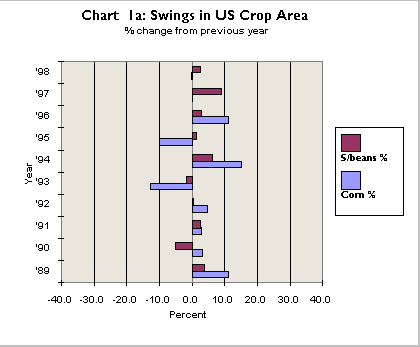
The choice between maize and soya bean production faced by US Corn Belt farmers has always received a great deal of attention. The area of one tends to go up when the other falls, or at least one changes much more than the other when both swing in the same direction (Chart 1a).
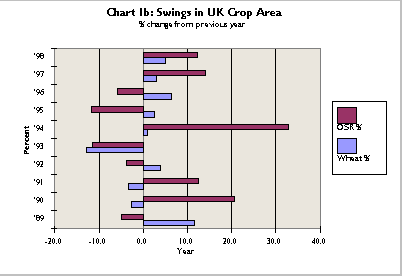
Perhaps surprisingly the swings in UK production between wheat and oilseed rape (OSR) have been greater than the more celebrated US example (Chart 1b). US swings in plantings receive more attention as the areas involved are much larger and, particularly for maize, have often had an important impact of international prices.
Both UK and US farmers face some agronomic limits when switching crops. Also, weather conditions may often be a factor. The US substitution of soya bean for maize when seeding is delayed is an example. The increase in UK spring barley area this year at the expense of winter cereals was almost certainly caused by the wet autumn rather than any market force.
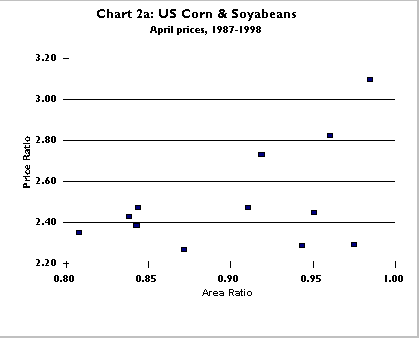
Price relationships between the soya beans and maize are, however, an important influence in the US (Chart 2a). But the UK profit motivation has in the past had more to do with EU CAP program changes than open market prices. This influence, however, has and will continue to decline, as EU cereal programs are reformed.
Although US farmers still have some degree of government program price protection, the market, and the future markets in particular, has always influenced farmers seeding plans. Importantly, the well-developed US futures market gives them the chance to hedge or forward price. This is critical as the relationship between new crop prices before seeding and seeded area may not hold until the crop is marketed. See the side bar.
For UK farmer the decision to change drilling plans to take advantage of market prospects is more difficult than for his US counterpart. In the first place, as the major options are autumn-seeded, decisions have to be made twelve rather than six months before harvest. The extra six months adds to risk. Also as European futures markets are less developed, meaningful price signals are more difficult to come by and forward pricing is more difficult and often expensive.
In the past, of course, this was not too critical as EU program adjustments, the basis for most farmers’ drilling decisions, were made before autumn seeding and not subject to change until the crop was marketed. The relatively slow development of European grain futures markets almost certainly reflects this. It is, therefore, something of a “chicken and egg” situation.
Although the LIFFE, the UK grain futures market, does make new crop grain contracts available for trading and prices are quoted when farmers are making final drilling decisions, the volume of trade is limited. This means these contracts can be difficult to trade. In turn grain traders often have to take wider margins than they would for more heavily traded contracts when offering farmers new crop price contracts.
It is, therefore, important that farmers contact their buyers to get new crop quotations. They should not just assume that they will be able to get a price as close to the quoted futures price as they can for a spot cash deal.
With time, and as the demand for forward pricing of new crop grain in the autumn develops, the volume of futures market trade in these contracts will increase. This in turn will improve this type of trade.
Even though forward pricing may be difficult, it is an important marketing tool for farmers. When faced with an apparent market advantage reflected in new crop prices, farmers should be aware that price relationships can change rapidly. Indeed such price advantages will as likely as not disappear, as they encourage the adjustments in production and supply that created them in the first place.
Foot Note: Seeding Decision in the US Corn Belt
While US wheat producers in the major winter wheat growing area have limited cropping alternative, in the US mid west Corn Belt farmers can switch acreage between maize and soya beans. As costs of production of the two alternatives are relatively fixed in the short term, price prospects for the two crops are important to cropping decisions.
Further the Chicago Board of Trade futures market not only provides them with a good indication of what those prospects are when they are making these decisions. It also makes forward pricing quite simple. It is, therefore, not surprising that as the ratio of soya bean to maize prices in April when farmers are completing their cropping plans, and thus the incentive to grow soya beans, increases, so the ratio of soya bean to corn acreage increases.
Over the last twelve years higher price ratios have tended to result in high area ratios, and vice-versa. See chart 2a. As other factors are always at play, the trend line is not very tight. By way of example in 1998, a high soyabean corn price ratio did produce an increase in soyabean area and a decline in corn area in the US corn belt, but poor wheat price prospects resulted in an increase in corn acreage outside the Corn Belt masking the Corn Belt adjustment in maize area.
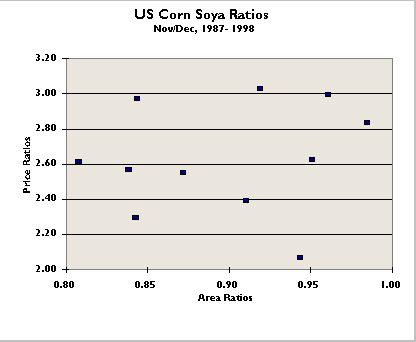
The trend, however, is very much less distinct when post harvest price ratios are plotted against area ratios. See Chart 2b. The implications of this is that there has been little advantage for US farmers adjusting their seeding plans to take advantage of price prospects, if at the same time they did not forward price.
David Walker 01603 705153
top of page