Home Page | Recent Opinion | Chronologies | Archive | About The I-Opener
 |
Intervention and the UK cereal market-Monday, November 22, 1999 |
This analysis featured in the November 22, 1999 issue of the HGCA's MI Prospect, Volume 2, Number 11
Key Points
- Price support fallen over 20% since MacShary reforms
- Tighter quality criteria reduced direct support for UK
- And the euro now means sterling prices need protecting
This article outlines the role of Intervention in UK cereal markets. It reviews how the EU intervention support mechanism has been eroded. And, it illustrates the relationship between intervention and the market over the last 30 months.
How intervention supports the market
Intervention support prices, at which member state Intervention Boards buy grain to support market prices, are set by the European Union in advance of the crop year. In theory, when market prices fall below the intervention level, offering grain for intervention becomes the best sale option and the market is supported at the intervention price.
In practice, the intervention grain has to meet quality specifications stricter than normal market specifications. There can also be extra costs involved in offering grain for intervention, which are reflected in the resulting ex-farm price. The intervention price changes in season with the sterling-euro exchange rate. Adjustments are also made to the euro-denominated intervention price between crop seasons and within the season by the addition of monthly increments.
Actual prices received by farmers for grain offered for intervention are generally below the intervention prices (see Graph 1). As are prices for grain destined for regular consumption channels.
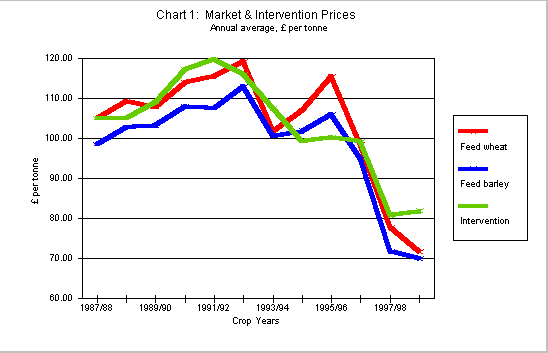
The exception to this is when intervention is not a market factor and the natural market forces of supply and demand set prices. This was the case for much of the 1995/96 and 1996/97 crop years. It was not until the 1997/98 crop year that the impact of the MacSharry reforms in terms of both a lower support level and a less effective mechanism for the UK were felt.
The Exchange Rate Factor
Before the 1993 MacSharry Reforms were implemented for the 1993-94 crop year, the ecu support price was converted to national currencies at fixed exchange rates. A secondary mechanism of Monetary Compensation Amounts offset the impact of changes in exchange rates when grain was traded between member states.
Between 1993 and January 1999 special green rates were used to convert ecu-denominated support into sterling. These green rates were periodically adjusted, when they varied from market rates by more than a certain amount.
Since January, exchange rates for calculating intervention prices in non-Euro member states have been adjusted daily.
The strength of sterling is often blamed for most of the recent decline in market prices. While the exchange rate is the major factor influencing prices on a day to day basis, it has played a more modest role in the longer term. The 1993 MacSharry reforms have had as much impact. In nominal ecu/euro terms intervention support has declined by about 23 percent since 1993. UK prices have decline by about 30 percent. The strength of sterling relative to 1993, and other changes in the intervention scheme, combined to add the extra seven percent.
The weakness of sterling in the mid-1990's, together with a strong world cereal market, masked impact of the MacSharry Reforms until quite recently.
Quality Considerations
By eliminating intervention for feed wheat and setting a single intervention price for all cereals, the MacSharry Reforms effectively reduced intervention support for UK wheat to below that for barley. Whereas most UK barley meets intervention standards, the same is not true for UK wheat. The support for feed wheat is indirect in part through the replacement of barley by wheat in UK feed markets and in part through competition for markets in other member states. Not only has the nominal level of support been lowered, but the manner in which it is provided has further reduced its effectiveness. Discussions are currently taking place about possibly lifting quality specifications for intervention wheat further.
Barley was briefly at a premium to wheat during the winter months of 1994, but stronger markets over the next three years resulted in more typical wheat barley prices relationships. It was not until the spring of 1998 that major European wheat markets settled to the intervention floor.
Costs of Getting Grain into Intervention
The cost of offering grain into intervention are relatively constant. As cereal prices fall, however, they become of increasing importance to farmers’ net returns and the effective market support provided by intervention. Prior to the MacSharry Reforms, when prices were in the £100 per tonne plus range, wheat markets were usually supported at above 95 percent of the nominal intervention price and barley prices above 90 percent. In 1998/99 average Corn Return prices for feed wheat and barley were respectively 88 and 85 percent of the nominal intervention price.
Price Trends since July 1997
At the start of the 1997/98 season, UK cereal prices were at or above the intervention support level (see graph 2). It was not until March 1998 that the discount to the nominal intervention price widened to a level that encouraged enough offerings of barley into intervention to halt the price slide. Significantly, the normal premium of feed wheat over feed barley was gradually eroded, with the two grains selling at par in April.
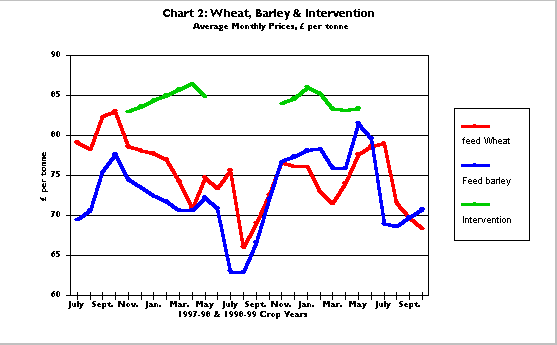
Wheat reestablished a small premium for about six months and until intervention stores opened in November 1998. At that time the market was largely dependent on invention for support. Feed barley maintained a premium of a fairly steady £7 to £8 per tonne over feed wheat until the end of the crop year. This was lower than during the previous season probably because the 1998 crop was of better quality and the movement of barley into invention was somewhat more orderly.
During the early weeks of this season, when new crop barley was competing with old crop wheat, feed wheat prices went to their usual premium to barley. As soon as new crop wheat supplies were available in volume, however, the wheat premium disappeared and barley went to a premium reflecting its value in the context of intervention and relatively strong export demand for barley.
Current Situation
In recent weeks feed barley has been trading at a small premium to feed wheat, but at a discount of £6 to £7 per tonne below the nominal intervention support price. East Coast export barley prices, which provide a more direct comparison with intervention, are at about a £2 per tonne discount, possibly reflecting the specific costs of offering grain for intervention and the higher quality criteria for intervention.
That there was not much barley offered into intervention when the stores opened is a result of a smaller crop and relatively good early export demand. The UK barley market appears less dependent on intervention volumes than it has done for the previous two seasons. This is not the situation generally elsewhere in Europe, so the potential for prices to move far off the intervention floor is limited.
In the past, the tendency was to treat intervention as a guaranteed minimum price. Green rates rarely changed and generally nearly two months notice was given of a change which would reduce sterling prices. Since last January, with daily exchange rate adjustments to the sterling support price, this strategy makes less sense. November intervention was worth over £85 per tonne in January, but a strengthening sterling has reduced this to around £77 at present.
David Walker 01603 705153
top of page