
North American Grain Review
- Monday, December 23, 2002
This analysis featured in the December 23, 2002 issue of the HGCA's MI Prospect, Volume 5, Number 13
With the exceptionally poor 2002/2003 North American grain supply conditions, resulting from very widespread drought, having been confirmed by final production estimates, interest has turned to demand prospects. While US export sales have continued at a respectable rate in view of limited supplies, prices continue to back off from their late summer highs.
Key points
- US and Canadian crops sharply lower
- Exports still OK, especially quality wheat
- Feed grain prices hit by Black Sea
- Barley availability sharply lower in Canada
- US 2003 winter wheat crop good
- Moisture in areas to be spring planted still a concern
Combined US and Canadian wheat production this year is estimated to be less than 60M tonnes, about two thirds of what might be regarded as a typical crop. Drought conditions prevailed over much of the main production region from southern Texas to northern Alberta. Moisture reserves were at low levels in the spring and were not replenished by sufficient rainfall during the growing season to sustain crop development.
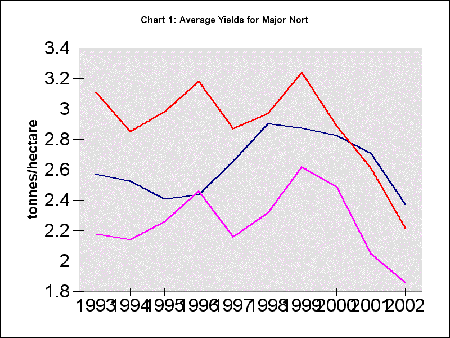
This drought was sufficiently severe and widespread to have a material impact on overall yields (see graph 1). The average US wheat yield of 2.37 tonnes per hectare was the lowest since 1991. Wheat yields in Canada were cut for a second successive year to a level not seen since 1989.
continueChart 1
continued
Northern American coarse grain production is estimated at 265M tonnes, about 10 percent below a typical crop. Moisture conditions in the US Corn Belt were, in fact, favourable in the spring, but a hot and relatively dry July for the critical silking period reduced yields around 0.75t/ha below the long-term trend.
End-season stocks of North American grain have been reduced in recent years, and particularly so by last year's drought on the Canadian Prairies. Combined with smaller crops these reduced carryover stocks further decreased the level of exportable supplies. It was apparent as early as July when the impact of the drought on yields started to emerge that the region would not play its traditionally dominant role in international grain markets.
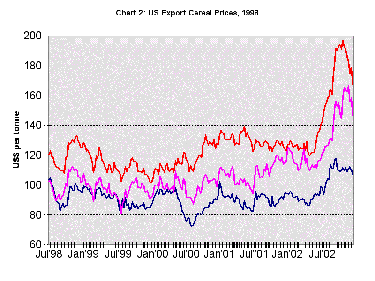
North American grain prices rose to reflect the need for the rationing of limited supplies, particularly for better quality wheat, supplies of which were most restricted by the drought (see graph 2). At the time this seemed a rational market response in view of the dominant role North America grain supplies have traditionally played in world markets.
continueChart 2
continued
With the emergence of Black Sea ports as a continuing source of competitively priced grain, however, the increase in North American prices has looked progressively less sustainable, particularly for feed quality grain. But US export sales have been well maintained, despite premium prices. In early December cumulative US export commitments for wheat and corn were only four and seven percent, respectively, below year-ago levels despite substantially reduced supplies.
Against this, however, both Canada and the US have imported feed wheat from non- traditional sources, for Canada the Ukraine and for the US, of course, UK wheat.
The USDA still projects that end of season stocks will fall to 9.5M tonnes. This would result in a stock to use ratio of 16.4 percent, down from 35.9 last year, and the tightest supply balance since 1995-96 (see table 1). Maize stocks are projected to fall to 21.4M tonnes with a stock to use ratio of 8.6 percent down from 16.4, also indicating a tight supply situation. In retrospect the response of US markets to this tight supply situation has been relatively muted. The USDA estimated average farm gate prices of US$4.55 per bushel in 1995-96 compared with current projections of US$3.65 - US$3.95 for this crop year.
continue
Table 1:  Summary US Supply and Demand

Wheat
'000 tonnes 1998-99   1999-00   2000-01   2001-02   2002-03
                                        estimated projected
Carry in     19,650    25,740    25,850    23,850    21,150
Production   69,330    62,570    60,760    53,260    43,990
Imports       2,803     2,586     2,449     2,939     2,177
Supply       91,783    90,896    89,059    80,049    67,317


Domestic use 37,694    35,381    36,306    32,714    31,734
Exports      28,359    29,665    28,903    26,155    25,855
Carry out    25,740    25,850    23,850    21,150     9,460
Disposition  91,793    90,896    89,060    80,018    67,049

Coarse Grains
'000 tonnes 1998-99   1999-00   2000-01   2001-02   2002-03
                                        estimated projected
Carry in     38,100    51,370    48,860    52,700    45,090
Production  271,470   263,170   273,130   261,860   245,230
Imports         300       270       260       240       260
Supply      309,870   314,810   322,250   314,800   290,580


Domestic use205,000   211,700   215,100   217,000   213,100
Exports      55,900    56,400    56,600    54,700    55,000
Carry out    51,370    48,860    52,700    45,090    24,760
Disposition 312,270   316,960   324,400   316,790   292,860

Source:  United States Department of Agriculture, December 2002
But despite this, prices have continued to decline over the last few months. US wheat prices are still above price levels that prevailed before the drought, but those for feed grain, and specifically maize, have backed off to close to their summer levels.
Following a second successive drought reduced crop Canadian wheat exports are currently projected by Agriculture Canada to fall below 10M tonnes, less than half normal levels and the lowest level since 1969 (see table 2). Not only were yields cut by drought but quality was reduced by early frosts and difficult harvest conditions. A larger than usual proportion of the crop will be fed, supplementing short feed grain supplies.
continue
Table 2:  Summary Canadian Supply and Demand

Wheat
'000 tonnes    1998-99  1999-00  2000-01   2001-02   2002-03
                                         estimated projected
Carry in         6,009    7,425    7,699     9,658     6,488
Production      24,082   26,941   26,519    20,568    15,690
Imports             80       14       60        97       235
Supply          30,171   34,380   34,278    30,323    22,413


Domestic use     8,023    8,368    7,511     7,628     8,563
Exports         14,723   18,313   17,110    16,207     9,500
Carry out        7,425    7,699    9,658     6,488     4,350
Disposition     30,171   34,380   34,279    30,323    22,413

Coarse Grains
'000 tonnes    1998-99  1999-00  2000-01   2001-02   2002-03
                                         estimated projected
Carry in         4,260    4,876    5,673     4,327     3,470
Production      26,575   26,832   24,031    22,600    19,589
Imports            952    1,064    2,925     4,051     4,920
Supply          31,787   32,772   32,629    30,978    27,979


Domestic use    22,829   22,864   23,707    24,068    22,549
Exports          4,081    4,235    4,594     3,439     2,540
Carry out        4,876    5,673    4,327     3,470     2,890
Disposition     31,786   32,772   32,628    30,977    27,979

Source: Agriculture and Agri-Food Canada, December 2002
Carry-out stocks of Canadian wheat are forecast to decline to 3.5M tonnes, the lowest level in over 40 years. The Canadian Wheat Board is projecting pool returns, average prices for the season, for No.1 CWRS 11.5% protein of Can$292, equivalent to £120 per tonne, in-store at Vancouver/St. Lawrence ports.
From a production standpoint about the only crop to do relatively well this year was durum wheat. Area was increased and, as it is mainly grown in the southern Prairies and away from the worse effect drought areas, output increased.
Canadian barley exports, including malt, are projected to reach only 850,000 tonnes, a third of what might be expected in a typical year and the lowest level since 1968. Feed barley exports will be next to zero, and after allowance for 6-row malting barley shipments to the US and malt exports, actual 2-row barley exports are likely to be only around 300,000 tonnes.
The direction of North American prices, and, indeed, those of international grain markets generally, for the balance of the season are likely to be determined by the availability of Black Sea port grain, whether Ukranian or Russian. It is evident, however, that North American grain supplies will be very tight at least until the 2003 harvest.
It is too early to make any definitive assessment of 2003 North American production prospects. But the condition of US winter wheats in late November was improved over a year ago, with a 61 percent good or excellent condition rating compared with 44 percent a year ago. Informal surveys also point to an 8% to 10% increase in US winter wheat area. Improved crop prospects are most evident in the southern Great Plains states, including Kansas and Texas.
Sub soil moisture levels are, however, more severe in the most drought affected areas of western Canada than a year ago. Spring seeded crops in these areas will certainly require above average rainfall next summer to achieve average yields.
David Walker
phone: 01603 705153
top of page